
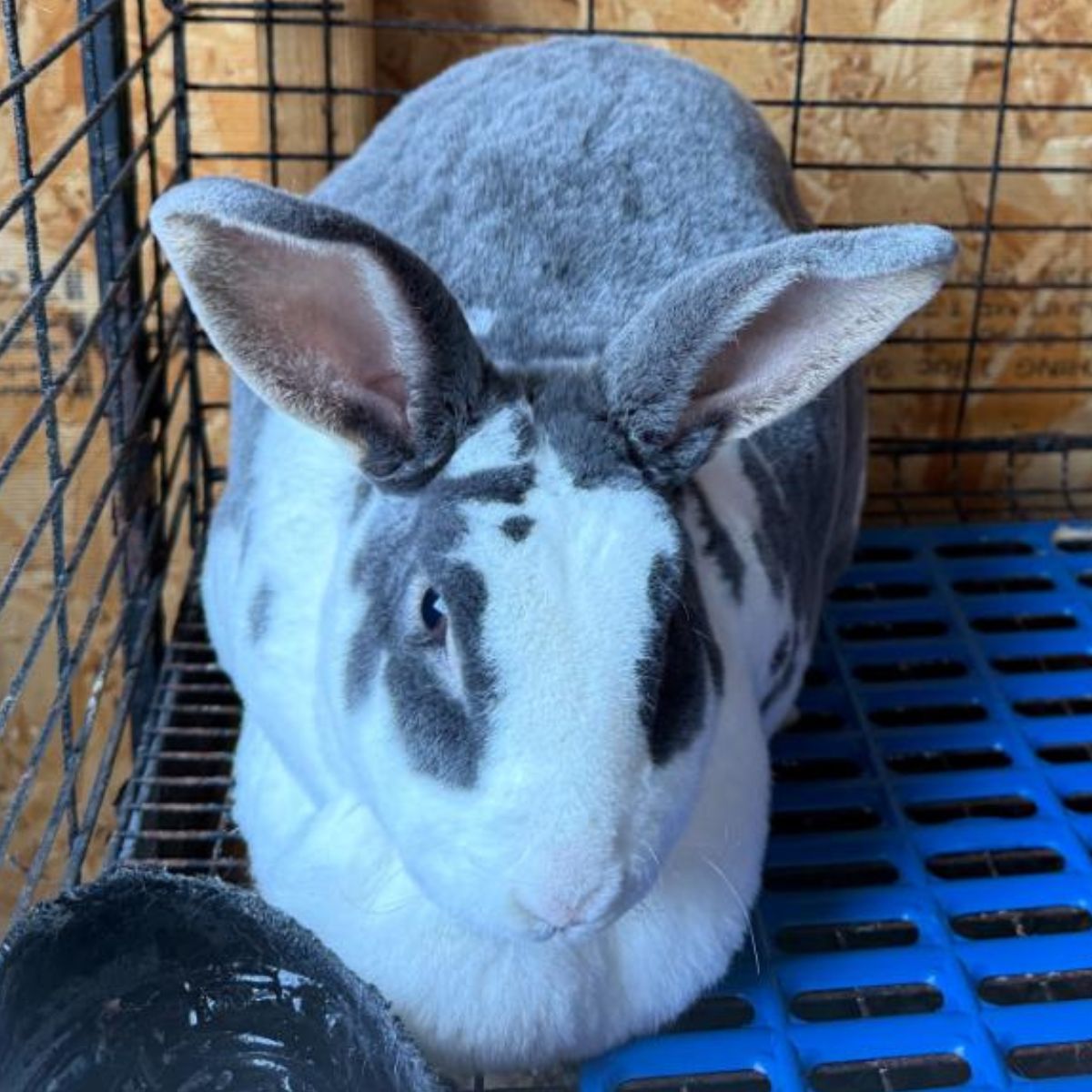
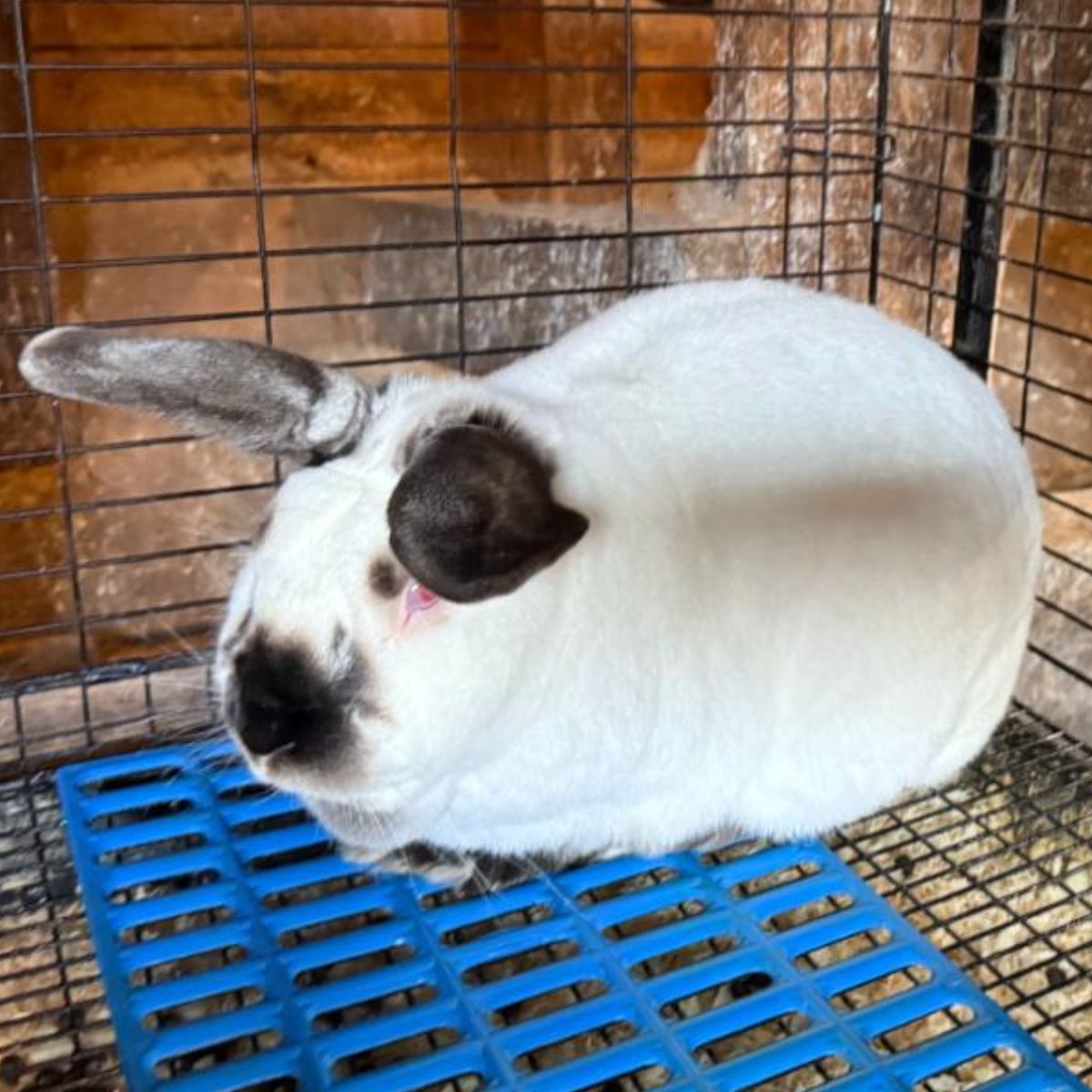
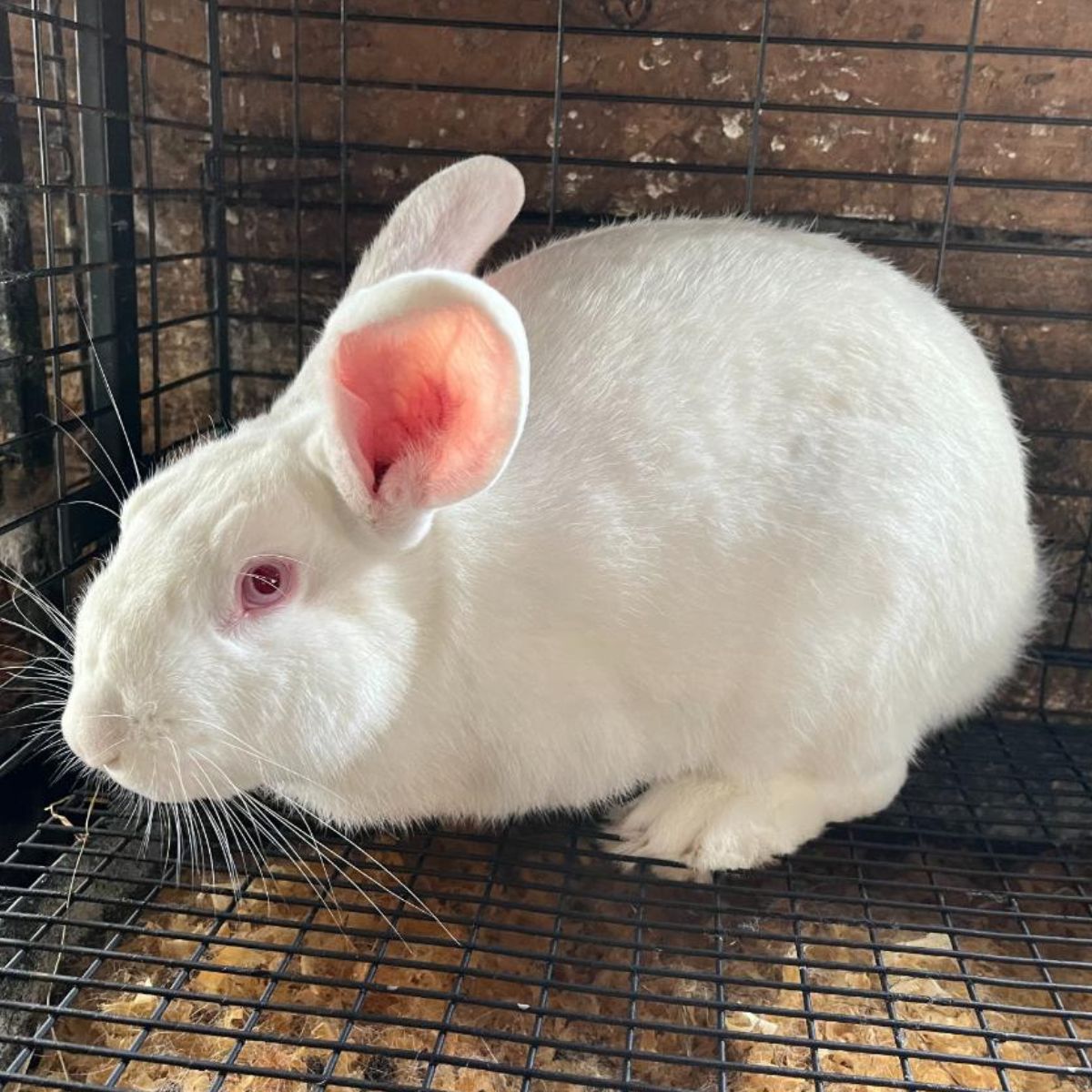
I’ve been hinting about this for a while now (if not outright saying so!). Along with the New Zealand and Californian rabbits that I started my rabbitry with, I’ve added a new breed of meat rabbit to my rabbitry this year.

The breed?
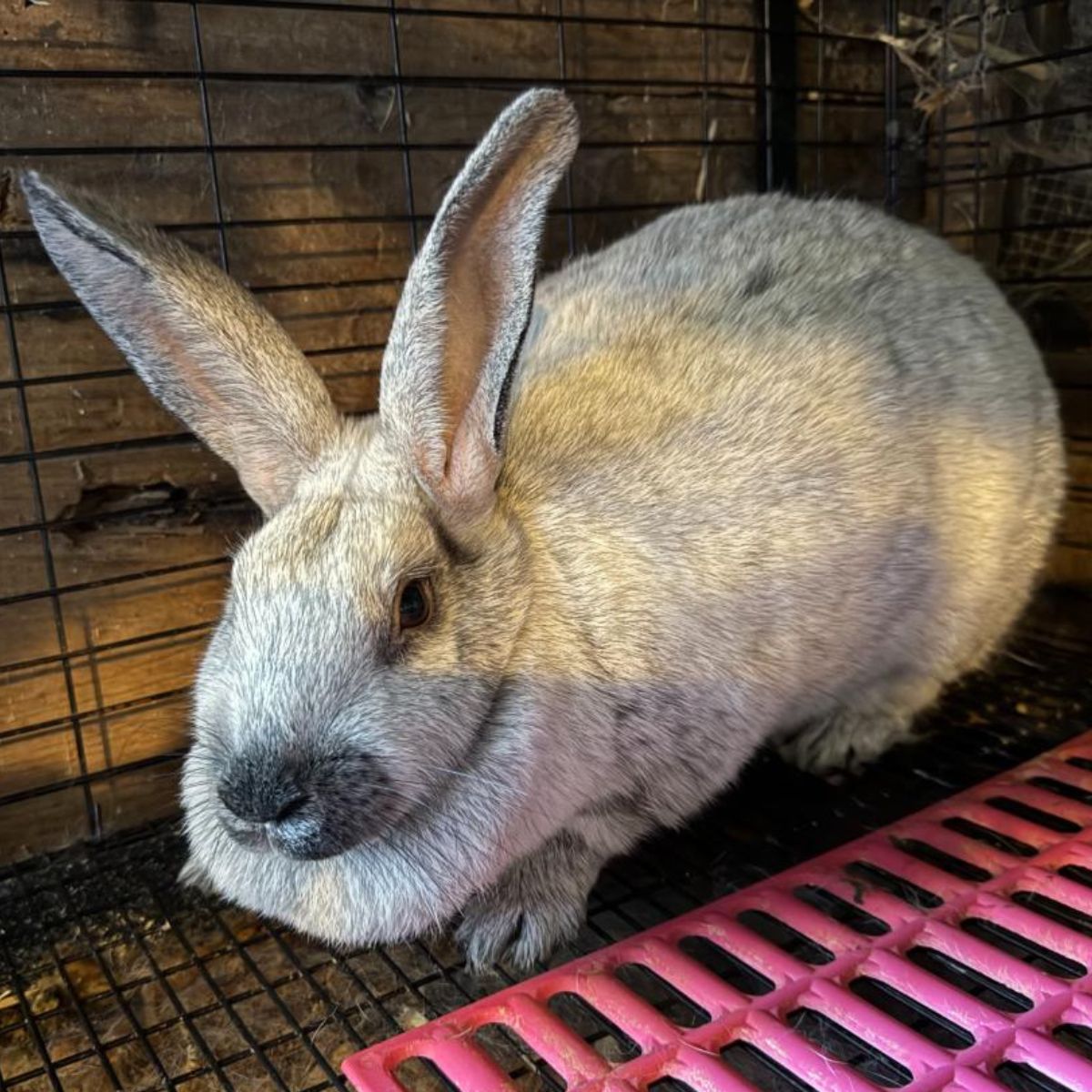
Champagne d’Argent.
Here’s a look at what attracted me to this breed and why I decided to start keeping them.
Jump to:
- Why I Chose to Add Champagne D’Argent Rabbits to My Meat Rabbits
- 1. Fast growth rates
- 2. “Thrifty, easy keepers” (At least from my breeder’s lines.)
- 3. Good bone to meat ratio
- 4. Friendly, calm, sweet temperaments
- On the Champagne d’Argent temperament
- 5. Easy handling
- 6. Good mothering instincts
- 7. Good, manageable litter size
- 8. Dual-purpose meat and fur breed
- 9. Heritage breed and conservation
- 10. Good homestead breed
- 11. Able to withstand cold winters
- My experience with Champagnes in this past summer’s heat
- 12. Color changing fun
- 13. Pretty, silvery adult pelts
- 14. Potential sales of breeding stock with multiple sales outlets
- 15. They seemed fun and interesting!
- Keep in Mind, Any Rabbit Breed is Only As Good as Its Breeding
Why I Chose to Add Champagne D’Argent Rabbits to My Meat Rabbits
I’ve had my eye on this breed for quite some time. I first came across it when I found Brick House Acres Rabbitry’s site and their home meat rabbit processing course (an excellent, low-cost, value-packed resource for new meat rabbit raisers and processors!).
There was a lot that piqued my curiosity about this breed. It’s not an uncommon breed, but it isn’t one of the most popular or widely available, either. I did have to travel to find them, but it was a nice day trip and, so far, proving worth the ride.
I started with two breeding pairs that were eight to twelve weeks old when purchased. I bought them in the spring, but they are just now reaching breeding age (as of the end of August 2024).
I’ve attempted one breeding. Hopefully, we will have Champagne kits in boxes in October.
What follows here is a list of the characteristics and reasons why I thought this breed would be worth my while. A lot of this has proven out for me already, but there are some things that can only be really known as this breed starts reproducing for me and as I start working (and weighing) litters. More updates will come in the future!
So, what was it about this breed that grabbed me?
Several things, in fact:
1. Fast growth rates

My focus is raising rabbits for meat. So good growth rates and efficient meat production are a must. It’s my primary focus.
Research tells me that the Champagne d’Argents should reliably reach 5 pounds by 8 to 10 weeks of age.
I usually raise my rabbits to an age of 16 weeks before harvesting. (I prefer more meat on my animals for my time and investment. In tracking my Californians, New Zealands, and crosses of those two, I find they continue to gain at a rate of one-half pound per week through and beyond this age, up to at least 20 weeks).
At 16 weeks with Champagnes, I expect a good to excellent growth rate of 7 to 8.5 pounds. I will have more on this as we have litters of champagne grow outs to track.
By ARBA standards Champagne d’Argents should top out at a maximum of 12 pounds at maturity.
2. “Thrifty, easy keepers” (At least from my breeder’s lines.)
The rabbits I have purchased are known to be “thrifty, easy keepers.” This is a trait of Champagne d’Argents that is in line with them having good, quick growth rates without having to develop any kind of fine-tuned or extraneous feed program.
The breeder I purchased from has targeted this as a goal in her lines and in her rabbitry.
By this, she means that these animals grow well and quickly with standard feed and/or only supplementation with homestead-type feeds like your typical 16% or 18% pellets. (She feeds 16% and finds that increased protein can sometimes cause loose stools, at least in the brand that is available to her locally, so it isn’t always worth trying to pay for more protein).
The only supplementation she does is to feed hay and a mix of green foraged foods, including various yard plants and herbs.
By no means do these rabbits have to have the supplemental feeds, but they do do well on them and it is an option that allows for growers to reduce the cost of commercial feeds (pellets) by adding in things like hay, grain, and fodder to the dietary plan.
These rabbits do well and continue to grow well without designer feeds. They also maintain a good growth rate with hay in the diet (which is typically cheaper than pellets).
I’ve maintained a diet of 16% pellets and supplemental hay, which is the diet I have always preferred with my rabbits and have had very good success with. These four champagnes that I have now grown well on this diet have beautiful coats and solid, firm muscling.
Again, I need to note here that we have not had a litter to raise as grow outs yet, so we will see how this translates into meat production; but all signs in the breeding stock point to promising things on what is a very accessible, affordable diet.
3. Good bone to meat ratio

Champagnes are known to have a good bone-to-meat ratio, similar to the Californian breed.
This is something I will be able to comment on more as I begin to harvest and process meat grow outs in the coming months. It is a feature that I look for and one of the reasons why I selected this breed.
4. Friendly, calm, sweet temperaments
Temperament is one of the top criteria for selection in my rabbitry. I will not tolerate mean rabbits or rabbits that bite. Scratching is a bit par for the course, and if it is something that happens as a byproduct of rabbit raising (in other words, not out of aggressiveness or meanness), I will overlook it.
Champagnes are known as quiet, friendly animals that do not scare easily. They are friendly, calm and sweet.
These are characteristics I want in my rabbitry for a few reasons:
- I don’t enjoy being bit.
- I have youngsters in my rabbitry now and then and want to welcome them to the world of meat rabbits without fear or bad experiences.
- Good temper means the animals can be sold as pets, too.
- It’s easier to help others get started with meat rabbits if they are not afraid of them.
- It’s an overall safer and more enjoyable experience.
On the Champagne d’Argent temperament

I do have this to say. At the beginning I wasn’t sure if I was noticing any significant difference from my Californians or New Zealands. In part, that would be because I have always selected for temperament; I have my hands in cages daily, so the rabbits are used to human hands, and I cull heavily for attitude issues.
As the champagnes settled and matured, I did notice that they are the friendliest rabbits in my rabbitry.
I see none of the flightiness or startle that the New Zealands sometimes express. I see little to none of the quiet, skittishness that some of the Californians display.
The two champagne does that I have are very friendly and one in particular greets me at her cage door every time I go in. She is so friendly; she is like a brick, happy to sit and be pet. On the contrary -- if you need to move her out of the way, you have to give her a solid, friendly nudge or physically pick her up and move her. She’s just that sweet and calm!
The males may be a little less friendly, but that is only to say that they took a little longer and slower movement to warm to sit for petting. This is in comparison to the does, and with just a tiny bit of effort (more like making a point), they quickly came to the point of expecting a pet, too.
5. Easy handling

There are things you’ll need to do in your rabbitry for the health of your rabbits that means they will have to be handled periodically. This is true even if you aren't one who wants to hold and pet your rabbits every day.
Throughout the year, you will need
- To be able to pick up and remove rabbits from the cage to move them
- Be able to check rabbits' bodies’, including turning them over to look at the undersides and various parts of the body
- Treat an injury, sore, or issue if something should arise
- Trim nails several times a year
- Move does to bucks’ cages for breeding and back again
- Be able to safely reach into a buck’s cage without being attacked
- The same for does -- more so because they will be protecting babies!
The better the temperament, the more trusting the rabbit, and the easier it will be to handle them as needed.
So far, these champagnes have proven very easy to handle. They are the easiest and calmest rabbits in the rabbitry and the least bothered by being picked up and handled.
6. Good mothering instincts
I can’t speak to this from personal experience yet. If the high heat we had this past summer has not caused temporary sterility issues in the bucks, I should be able to update on this soon.
Champagne does are known to be good mothers that care well for their young and possess good mothering instincts.
Good mothers mean limited losses and more kits to grow for food.
7. Good, manageable litter size

Champagnes are known to have litters of 6 to 8 or more. This is a large enough litter size to be worthwhile from a production standpoint but also not an excessively large litter size that can’t be handled by the doe.
Rabbit does average 8 or 10 nipples on a doe, and though does can often raise more than that. Ideally, there is at least one nipple per kit (since rabbits don’t spend a lot of time nursing their young).
Many breeders breed two does at a time so there is an option to foster extra kits, but an even better situation is for the mother to be able to raise all her young without relying on fostering (because that foster might have all she can handle, too!).
8. Dual-purpose meat and fur breed
Champagne d’Argents are a good dual-purpose rabbit if you are looking for both a meat and a fur breed.
I have not yet done anything with pelts other than make treats for my dogs, but it’s nice to have the option.
And if there is a breed that will convince me to do that, it is probably the Champagnes!
They have a lovely two-toned silver coat as adult rabbits and I’ve never petted a softer fur. And this on only 16% feed!
I also have people interested in pelts, and these would make beautiful specimens for them.
9. Heritage breed and conservation

The Champagne D’Argent rabbit breed is a heritage breed of rabbit, probably dating back to the 1600’s.
They are not currently listed as a threatened or declining breed by the Livestock Conservancy. However, they are one of the lesser-known breeds, at least in comparison to the go-to Californian and New Zealand rabbit breeds (as evidenced, in part, by the limited availability of breeding stock).
Relatives of the Champagnes are listed as being under a conservancy “watch.” These are the Creme d’Argents. Both are among the seven of the Argente rabbit breeds.
That said, as a breed that is less commonly kept, the more breeders there are, the safer this breed is from becoming endangered like their cousins are.
It is up to us as breeders to keep their numbers up so they don't fall behind.
Also, the more people who breed them, the wider the gene pool is, and the more choices and selections we have to keep genetics good and the breed productive.
10. Good homestead breed
Heritage animal breeds often make good homestead rabbits, for similar reasons as those listed here. They’ve only become the lesser-known and less popular breeds usually because of some arbitrary whim or demand within the industry (like having all white pelts or suitability as a lab breed).
Often, these breeds that fell behind due to commercial production have strong characteristics that make them excellent backyard and homestead animals.
In this way, they are not dissimilar to a lot of other types of animals (and even vegetables) that are, in fact, superior in many ways to what is commercially popular.
The commercial doesn’t always mean “best.”
11. Able to withstand cold winters

Champagnes, as a dual-purpose fur animal, grow good coats and handle winters well. They do well in northern locations.
Some people do report some issues in high heat and in southern areas. This is because they are heavier coated and well adapted to more northerly areas.
Champagnes can still take some heat, but if you have regular, steady, consistent temperatures of 90 or above for long periods, you may want to consider a different breed, like the heat-tolerant Tamuks.
That said, this is true of many meat breeds. Tamuks and others have been developed expressly to overcome this common issue with meat rabbits.
My experience with Champagnes in this past summer’s heat
I can speak on this issue a bit. We had many days over 90℉ this past summer. Having a few days of 90 is not unheard of here, but they are normally limited to a day or two at a time, or at most, a couple of heat waves that are spread out.
This year, we had more days close together that were at 90 or near to it. We experienced around 21 days of 90+ degree heat (with humidity), where 10 is about average. We also had four heat waves, where two are more typical.
So, this summer is a good, above-average indication of how these rabbits can handle my summers.
My rabbits are kept in a barn with shade and good airflow. Despite the 90-degree weather, the champagnes handled it just fine. I expect my setup helps with this issue. Even in the high heat of summer, my barn is pretty comfortable.
This is a fine, promising start for me. I will be watching this issue as we progress through the years with this breed. I need the winter tolerance but also reasonable summer tolerance, too. Running air conditioners and taking on high utility bills is not my goal. I aim for easy, reasonable keepers that don’t need to be babied.
12. Color changing fun

Champagne d’Argents are born black, and then, as they grow and mature, they go through color-changing variations as they age.
By the time they are mature adults, they are completely silver but with a sort of two-toned coat. The adults frequently keep some darker color around the nose and eyes.
In the in-between, the kits can be quite cute and interesting. Many sport cute dark “top hat” looks.
13. Pretty, silvery adult pelts
The adult pelts are quite attractive. Mature rabbits six months to one-year-old are a bit darker, and older rabbits lighten into a lighter silvery gray.
As fur pelts, these are very attractive colors.
14. Potential sales of breeding stock with multiple sales outlets

Because they are a recognized and favorable, beneficial breed, and because they are reliable and good-tempered, there are a few avenues for sales of breeding stock and rabbits.
These include outlets for sales of meat, breeders, show animals, and pets.
15. They seemed fun and interesting!
Finally, one of my personal reasons for pursuing this breed is that they looked fun and interesting to me!
Is this a reason to choose a meat rabbit breed?
Why not??
I put many hours and a lot of work into my meat rabbits. Keeping a breed that interests me keeps me engaged.
I SHOULD enjoy my work!
I appreciate these animals for the sustenance they give me. I give them a good life. Part of that is enjoying each other during the time we are together. Including enjoying keeping breeders who I like (and maybe even love a little!).
Keep in Mind, Any Rabbit Breed is Only As Good as Its Breeding

With all of this said, do keep in mind that any rabbit breed is only ever going to be as good as the breeder and the program behind it.
Any breed can have many of these traits if they are selected and bred well.
And Champagnes can be poor quality, bad tempered animals if they are not selected and bred well and if they are mishandled, abused, or improperly cared for.
We as buyers and breeders need to do our part to consider the breeder, the animals on offer, and then carry on to perpetuate good things in the breed.
A breed type or name alone is never enough to guarantee good things, but it helps to know what you should be able to expect and then find the animals that meet that standard.
Please come back again and follow my journey with the Champagne d’Argent meat rabbit breed. We will see how well these rabbits “meat” my expectations and fulfill their reputation!

Jenny
We are forever searching for a buck. They seem to not be as hardy as the does. Any recommendations for the midwest? (Minnesota is where we would be traveling from )
Mary Ward
Interesting. That is your experience with bucks in general or specifically Champagne d'Argent bucks?
I would suggest checking out BHA Rabbitry's site. She maintains a directory of breeders. There are listing by state and location. There are listings for Minnesota. Good luck and let us know how it goes!
https://breeders.homesteadrabbits.com/
Shari Weber
I love my Champagne d'Argents! I too did a lot of research. I've had good luck with them, they personable and a joy to work with. Everyone expects a pet and a kiss when I feed them. I sell for show and for our meat. We are hoping to experiment with the pelts this year. We've been busy with other projects and have frozen them. You won't be disappointed.