
Rabbit bones make one of the most delicious, light, and flavorful bone broths there is. This is an excellent way to make the highest and best possible use of your meat rabbits.

After you bone out a rabbit, or with the leftover bones after roasting and eating a whole rabbit, save the bones for broth. This is both an efficient and minimal-waste way to use your meat rabbits. And it’s highly nutritious, as well as being good for gut health, skin and joint health, and much more.
Jump to:
What is Rabbit Stock or Bone Broth? Is it Stock? Broth? Bone Broth?
This is where things get a little confusing semantically. It’s all a matter of wordplay, practically speaking. And it doesn’t matter that much. But for the sake of argument...
Rabbit stock or bone broth is a liquid broth that is made by simmering the bones of rabbits to extract flavor and nutrients. In culinary terms, the stock is made from bones, usually mostly stripped of the skin, fat, and meat (but always with some bits of meat and flesh left on them). The broth is a simmered liquid that is made from meat, skin, and tissue, but that doesn’t necessarily include the bones.
And then, we have bone broth. Which sounds like something of a contradiction or misnomer since we just said that stock is made from bones and broth is from meat and soft tissues. And it is.
Even the experts agree it is confusing. Epicurious has a good explanation of what they came up with for a difference and definition here.
The gist of it is that bone broth is a more recent addition (spurred largely by Sally Fallon and the Weston A. Price Foundation) that is a bit of a hybrid. Bone broth is cooked for longer to extract more of the nutrients and collagen. It aims a little bit more at health purpose than just culinary uses. But it can be used in any of the ways you’d use stock or broth.
So, the bottom line? Don’t get too hung up on the names. Our goal as meat rabbit raisers is to get as much out of our rabbits and our hard work as we can. And bone broth (by any name) is a great way to put those bones to good use instead of just throwing them out.
How to Make Rabbit Bone Broth

Keep in mind that when you make your own bone broth, you have a lot of flexibility. It’s pretty hard to go wrong with bone broth. Even if you don’t cook it for long enough, you’ll still get a nice and flavorful stock that will be great for any soup and lots of other uses.
More of the flexibility comes in with seasonings and vegetables. Feel free to add or subtract as you like. For salt and spices, you might want to leave this to the end, or at least leave most of it to the end, so the flavor doesn’t concentrate as the liquid simmers and cooks down.
Rabbit Bone Broth Recipe
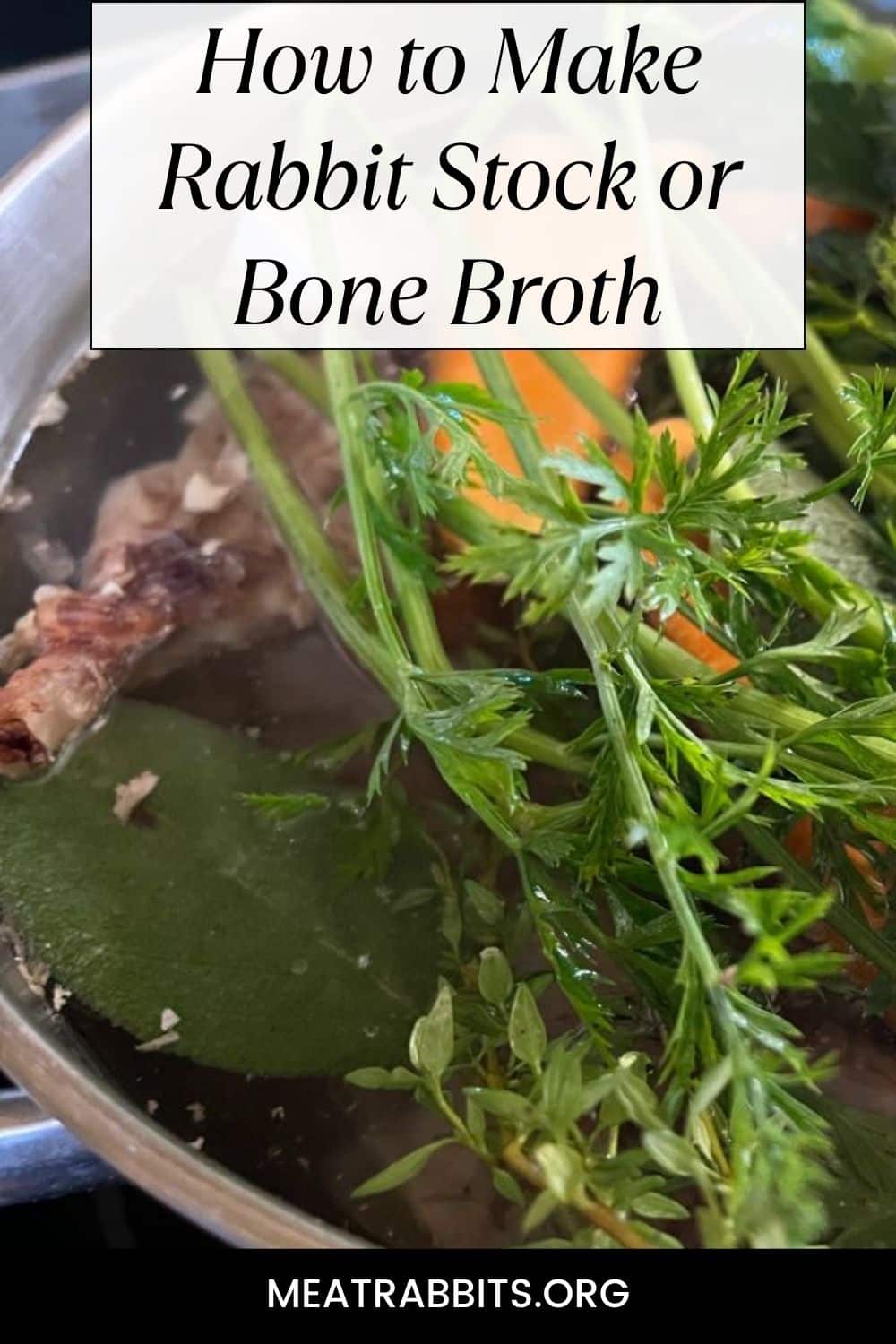
Now, on to the good stuff. Here’s a recipe for rabbit bone broth:
Ingredients:

- 4 pounds of rabbit bones*
- Cold water, enough to cover bones and vegetables**
- 2 or 3 large carrots, cleaned and cut in half
- 3 celery stalks, cut into large chunks
- 2 medium onions, quartered***
- 4 whole garlic cloves (can leave peel on or off)
- 1 teaspoon sea salt or kosher salt (avoid iodized that can cloud broth)
- 1 teaspoon whole peppercorns
- 2 to 3 tablespoons apple cider vinegar (ACV)****
- 2 bay leaves
- 4 springs of fresh thyme
- 6 sprigs fresh parsley
- 3 sprigs fresh rosemary
*This recipe adjusts easily for the amount of bones you have—just adjust other ingredients up or down accordingly.
**Always start with cold water. This helps to break proteins down slowly and improves the broth’s flavor.
***Wash the onion and cut the root off, but you can leave the peels on for added color.
****Apple cider vinegar (ACV) helps extract calcium, collagen, and other nutrients from the cartilage and bones. Some people are sensitive to its flavor, so you can reduce or eliminate it if you don’t like the taste.

Fresh herbs are better than dried because they don’t cloud the broth as much, but if dry is what you have, that’s fine too. Cloudiness in broth is only a matter of looks—the cloudy broth is perfectly fine and delicious. Feel free to adjust herbs and vegetables to taste, too.
Instructions:
- Roast the rabbit bones in a 375 F (190 C) oven until nicely browned. Roast for 35 to 45 minutes or until done. You can make these dark brown but not burned, which will give the broth more roasted flavor and color.*
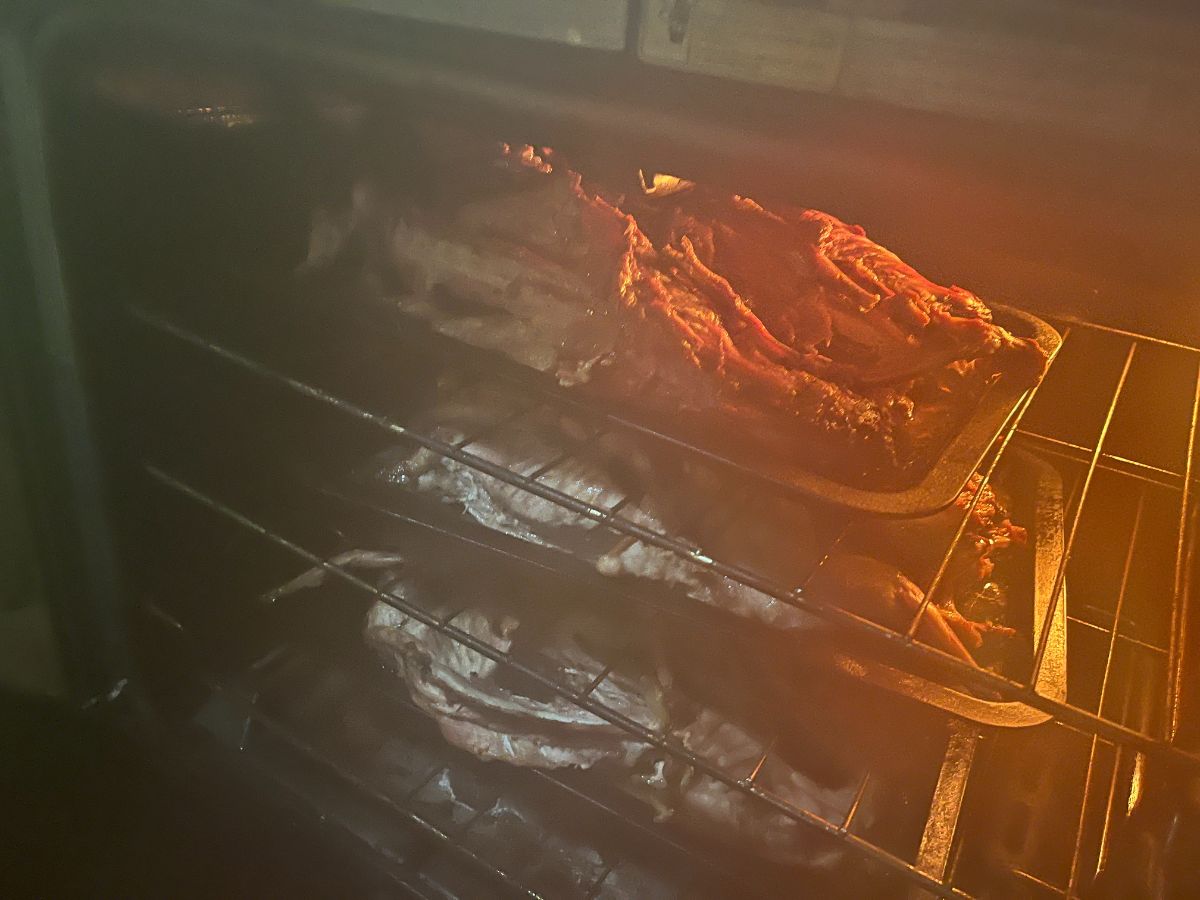
- Add the rabbit bones to a large stock pot. Scrape any drippings from the roasting pan.
- Cover the bones with water plus a little extra to cover vegetables.
- Add the vegetables, herbs, and spices to the pot. Add more water if needed.

- Start with the recommended amount of salt. If you want a saltier flavored broth, add the salt at the end, or when you are cooking or using the broth (this may be preferable so you can adjust according to the dish it is being used in and your cooked dish doesn’t end up too salty).
- Heat on medium-high until the pot comes to a simmer, then reduce heat to low.
- Maintain a low simmer. Skim fat and impurities that rise to the top a few times during heating.

- Simmer for 12 to 24 hours, maintaining a low simmer for the clearest broth and best nutrient extraction.

- Remove from heat. Let cool.
- Carefully strain the broth through a colander lined with cheesecloth or a cotton or muslin towel (wet the towel first so the broth passes easily through. Be sure to place a pan or large bowl under the colander to catch your broth!

- Place the strained broth in the refrigerator overnight. When cool, the fat will rise to the top and harden. Scoop the hardened fat off the top with a slotted spoon or skimmer (this is optional, so if you like the fat, you can leave it, but it does make a lower fat and lower calorie broth that is clearer and feels better in the mouth).

- Ladle finished broth into storage containers and freeze. Leave one inch of headspace at the top of the container to allow for expansion in the freezer.
- If you want your broth to be shelf stable, it will need to be pressure canned. Follow pressure canning instructions for a chicken or beef meat broth.
- If refrigerating, use the broth within one week or freeze it. Frozen broth is of the best quality if used within 3 to 6 months, but as long as it is maintained at a steady frozen temperature, it can last for 6 to 12 months or more.
*You can skip the roasting if you like. Roasting does start the breakdown of your bones and improves the flavor and color of the broth, but it is optional, and broth from raw bones is perfectly acceptable.
What if Your Rabbit Bone Broth is Cloudy?
This happens. Probably to everybody. And probably to some of us more than others.
Cloudiness happens for a few reasons, but the most common reason is cooking at too high a temp or a broth that boiled for a bit instead of just simmered on a low simmer. Truth be told, some of today’s stoves are so high-powered it can be hard not to do.
But it really doesn’t even matter. And some people will say (probably rightly so) that broth is always cloudy, and clear broth is consommé that has gone through a second clarifying process. Everyone agrees, though, that cloudy bone broth doesn’t matter. It’s a sign that proteins and collagen are emulsified in the broth, and the taste is just as good.
If it really bugs you, you can use this trick to clarify your rabbit broth with egg whites.
How to Use Rabbit Bone Broth

Using rabbit bone broth is easy, and there are many ways to use your bone broth.
Many people drink bone broth daily for gut and joint health, immune system support, weight control, sleep management, hydration, and a nutritional boost. You can also use it in your daily cooking as a way to easily incorporate more bone broth and its benefits into your diet.
Use rabbit bone broth in any recipe that you would use chicken stock or chicken broth. Here are some other ways you can use bone broth to get your daily dose and to bring a big flavor to your cooking, too!
- As a base for soups or stews
- As a braising liquid
- Cook pasta or rice in broth
- Sip like a tea or warm drink
- As a base for ramen and Asian bowls
- As a gravy base
- In gravy or sauce for pot pies
- In sauces
- To moisten bread stuffing, chili, casseroles, and more
- In mashed potatoes for a lower calorie, protein-boosting liquid
- In place of water when cooking vegetables
- To deglaze a pan for a pan sauce, etc.
- To make risotto
- In polenta
- For poaching meat, fish, or eggs
As you can see, there are many ways to put your rabbit bone broth to good, healthful, flavorful use. We’ve listed many, but you’re sure to find more. Having this many ways to use your broth makes this second-string rabbit product even more useful and money-saving, which means your rabbits are, too!
Amelia
I also made this from the chicken broth recipe from Sally Fallon just a few weeks ago. It’s the absolute best rabbit bone broth I’ve made so far. I did salt the meat / bones 24 hours beforehand with pickling salt. I also added the liver, hearts, etc. I’m glad I found your site, I’ve tried sausage but haven’t found a recipe that I want to keep using. I would like to try yours the next chance I get.
Mary Ward
Thanks for sharing! Hope you love it. We will be posting more sausage recipes in the near future, so please follow. I've got some good ones 🙂
Lauren
Thanks so much for this clear and tasty-looking recipe and guide! This will be my first time making bone broth, so I have a question. What’s the best thing to do with the bones (after cooking and eating the majority of the meat) before getting started making the broth? Can I keep them in the fridge, and if so, for how many days? I’ve just had a small amount of rabbit 1 today, so only have a few bones, but will be eating more in the week and it made sense to save em up until I had more for the pot. Do let me know what you think, and if there’s any reason to make up broth batches immediately rather than saving the bones in the fridge. Thanks!
Mary Ward
Hi Lauren,
I personally prefer to wait and get at least a few carcasses so that you can get more for the money or running your stove, crock pot, etc. It's pretty much the same amount of energy to make a larger batch as it is to make a smaller one, and you'll get better flavor and better gelling in a broth with more bones and connective tissues.
You can easily keep the bones in the fridge for three days as you wait to collect more. You could go up to five, but I'd try to cook them within three days. Basically, about the amount of time you'd keep leftover meat for eating. An easy way to do this is just to keep an add-on bag in your freezer. Put the first in a resealable bags or tupperware and then add carcasses as you produce them. Then, when you're ready to make your broth, the whole bag can just be dumped in. And then if you don't get to them when you expected to, you don't have to worry about it, either.
Hope that helps. If you have more questions, ask away!