
One of the trickier things to figure out when you are raising meat rabbits is when to harvest the grow outs.

What is the best age to slaughter meat rabbits for your freezer?
There are many opinions on the matter. That can make it difficult to land on what the “right” age is to harvest your meat rabbits.
Jump to:
- There is No Age When You Cannot Harvest or Eat a Meat Rabbit
- When to Harvest Meat Rabbits: Age vs. Weight
- The Most Common (Or at least the most often repeated) “Rule of Thumb”
- Common Rabbit Meat Age and Stage Terminology, Ages, and Weights
- Fryer
- Roaster
- Stew Rabbit or Stewer
- When I Personally Harvest Meat Rabbits
- No Right or Wrong Answer As To When You Should Harvest Meat Rabbits
- Things to Consider When Deciding on Harvest Weights or Ages
- Estimated Yield of Rabbit Meat
- Total percentage of edible parts from dressed rabbits + organs
- Best Advice: Take Weights, Do Math, and Experiment to Find What You Like
There is No Age When You Cannot Harvest or Eat a Meat Rabbit
Let’s get this out of the way first.
There is no age at which you cannot process and eat a rabbit.
Forums seem to get this question periodically -- How old is too old to harvest or eat a meat rabbit?
The fact is, rabbits are never too old to be eaten. Many growers eat their retired breeders.
The question would be more in how you should prepare or cook older rabbit meat. Low and slow or ground would be the answers there.
The point is, nothing happens to rabbit meat all of a sudden at a certain age that would render it all of a sudden inedible. The only consideration would be how tough the meat might be, hence, why you’ll need to decide how you want to cook it or cut or grind it.
When to Harvest Meat Rabbits: Age vs. Weight

When people talk about harvesting meat rabbits, two factors come into play.
One is age. The other is weight.
You can process according to either criteria, but the decision is really a combination of the two.
People generally make their decisions based mostly on age, backed up by live weight.
The typical ages to process rabbits are either 10 to 12 weeks or 16 weeks. Some grow out even longer, but usually, people fall into one of those two camps.
Of course, they expect that their rabbits will have reached a suitable live weight by these times. The weight range, respectively, would be between 5 pounds (live weight) and 8 pounds for rabbits in this age range (10 to 16 weeks).
The Most Common (Or at least the most often repeated) “Rule of Thumb”
If there is one most often repeated time to slaughter your meat rabbits, it is between the ages of 10 to 12 weeks and/or when the rabbits hit five pounds of live weight.
This is said to be the most efficient time to harvest. The balance of feed inputs to meat output is supposed to be the most favorable.
Meat texture is another reason why this is the “preferred” time to slaughter and harvest meat rabbits (a matter of opinion and not necessarily my own).
If you grow beyond this point rabbits are still a very efficient meat producing animal and you will continue to get high rates of gain. You will be harvesting animals two to three pounds heavier if they are grown out another four weeks to an age of 16 weeks. They will continue to gain past that point, too.
Common Rabbit Meat Age and Stage Terminology, Ages, and Weights

The following are mostly for reference and example. They do show you the range of weights and ages when rabbits are harvested.
This terminology is also what you would use if you were to market your rabbit meat. They are commercial terms that are used in the industry and markets.
They are helpful to homestead meat raisers to guide you in deciding when to harvest your meat rabbits and at what ages and weights.
Fryer
- 3 ½ to 5 pounds live weight
- Usually 8 to 10 weeks old and not older than 12 weeks old
- The USDA lists dressed fryer carcass weights as a minimum of 1 ½ pounds and usually not over 3 ½ pounds; this is dressed weight and would be equivalent to a range of 3 to 5 pounds live weight
Characteristics of Fryer Rabbit meat:
- Tender
- Fine-grained
- Light pearl-white to pink color
- Little to no fat
- Some people think fryer meat is too tender, without form or texture, leaning towards mushy (this is more true in younger fryers towards 8 or 10 weeks than in 12-week-old fryers; it is, at the end of the day, personal preference)
Roaster
Roasters as a finished rabbit product (carcass) are sometimes labeled as “Mature Rabbit.”
- 5 ½ to 9 pounds live weight
- 10 or 12 weeks to 6 months of age
Characteristics of Roaster Rabbit meat:
- Firmer than fryer meat
- Moderately coarse-grained
- White but slightly darker in color, with most dark meat being on the legs
- Cream-colored fat* (but not a lot of it)
- Has texture without being tough; firmness makes it easier to cut and work with
*There is not a lot of fat in rabbits. What there is lies outside the muscle. Rabbit fat is not marbleized like the fat in beef. You will find it mainly in two places: over the shoulders and inside the body cavity surrounding the organs.
Rabbit fat is easy to pull away, but it is also almost tasteless, so if you are looking to leave it to provide a bit more moisture, it’s fine to keep. I would recommend keeping what little fat there is if you are grinding the meat or making rabbit sausage.
Stew Rabbit or Stewer
- Rabbit over 6 months* of age
- Over 8 pounds live weight
Characteristics of Stew Rabbit meat:
- Firmer meat
- Coarse grained
- Firmer fat and more of it (still not a lot in comparison to other meat animals)
*Some resources list a stew rabbit as a rabbit over 5 months of age.
Basically, these are your rabbits that are done growing and have reached their age of maturity. They would be close to the limit of their mature weight, but if left to grow and age, they could get heavier depending on the breed and the limits of their mature weight.
Think of stew rabbits as the rabbits that are fully grown and breeding age or older.
This category can (and often does) include older cull rabbits, such as culled breeders or retired breeding rabbits.
Rabbits at this age have the toughest meat, and you would expect the meat on a stewer to be tough. (Especially if they are above 6 months old and are something like a culled breeder or failed breeder)
When cooking, you would want to use a slow stewing or long braising process to tenderize the meat.
These rabbits also make fine ground meat and then the meat can be cooked any way you would cook with ground meat.
When I Personally Harvest Meat Rabbits

My personal preference is to harvest my rabbits at 16 weeks. My reasons are these:
- I prefer more meat for my efforts
- It takes practically the same amount of time and effort to slaughter and process a 16-week-old rabbit as it does for an 8 to 10-week-old. But you get more meat for that effort (and if working in small body cavities is difficult, they have more room to move for the cutting and gutting)
- At 16 weeks week, my rabbits are averaging 7 to 8 pounds of live weight
- Yield is between 3.5 to 4.5 pounds per rabbit, with most averaging around 4 pounds (there will always be one or two smaller or larger in the group; my does are good mothers and seldomly lose runts)
- It only takes a short month to six weeks of extra feeding and work to gain a larger carcass with significantly more meat
- I feel the extra feed input is worth the extra meat, and I liken it to gaining a half litter’s worth of meat or more by not losing time to starting new kits -- it’s all in how the meat and time raising balances out
- We like the texture of the “older” meat just fine and do not consider it tough. Comparable to white meat chicken breast
- I make a lot of cuts and ground meat, and the texture for ground meat and sausage is much better on slightly older animals
- Mostly, it’s an issue of yield
I have weighed rabbits in several litters, and I find that my rabbits continue to grow at a rate of about one-half pounds per week after this stage. They easily do this to 16 weeks and even to 20.
Around that time, they start to get close to their mature weight and will still gain. It may slow down a bit. There is no appreciable weight gain after six months of age.
This is to say, I find this rate of gain to be in my favor and still a positive return on the feed investment.
No Right or Wrong Answer As To When You Should Harvest Meat Rabbits
There is no “right” or “wrong” answer when it comes to deciding when to harvest your meat rabbits. For anyone, it’s just a matter of personal preference.
There are a few management and housing issues that might sway you one way or another, but other than that, it’s your decision to make.
Things to Consider When Deciding on Harvest Weights or Ages

Following are some of the things that might help you decide on what your target harvest age will be:
Housing setup and availability
What you have available for cages or housing for grow outs may be a large determining factor on when you harvest your meat rabbits.
If you have a large enough cage, you can keep an entire litter together the whole time, until harvest, if you slaughter at a young enough age.
- Mixed sexes can be kept together in one or two larger cages or tractors if they are harvested by 12 weeks old
- After 12 weeks, hormones will cause fighting and problems
You can even keep more than one litter’s grow outs housed together if they are combined while they are still young enough.
- If you are combining grow outs from separate litters, combine them before they are 8 weeks old
- Rabbits from different litters that are combined after they reach 8 weeks will fight; before that, they will not
- Usually, you would combine the litters when they are weaned -- at 5 to 6 weeks old
An in between sort of option would be to keep a whole litter together up until 12 weeks and harvest at two different ages.
- At 12 weeks, harvest the males to avoid aggression and fighting
- This will also ease up cage congestion and give more room for the does to continue growing
- Let the does grow out to 16 weeks
- You can save the pelts from the does, and they are generally preferable to male pelts, said to them having suppler skin
Meat texture

Rabbit meat isn’t really just a matter of being “tender or tough.”
Some people experience younger meat as mushy or without texture rather than being really tender.
If you feel like young rabbit meat leans more toward mushy than tender, grow them out a bit longer. Once you get past 14 weeks, and surely past 16, this will not be the case.
Preferred Cooking Methods
Think about how you want to cook your meat.
- Do you prefer roasting whole animals and want size?
- Do you want more on a carcass?
- Are you a small household, and a larger carcass would mean leftovers or waste?
- Would you rather have more tender cuts of meat?
- Are frying pieces more to your liking?
- Will you do a lot of slow roasting, where firmer meat becomes a non-issue?
- Is shredded meat going to be your go-to?
Any rabbit, even an old rabbit, will come out great if it is lowly and slowly cooked. If fast frying is more in your plan, younger would probably be better.
That said, I cook and eat 16-week-old rabbit meat in every way (sauteed for Rabbit Marsala is a favorite), and no one here bats an eye at the texture. We make a lot of “Rabbit Nuggets”, too. At that age, I would compare it to fresh chicken thighs or breasts in texture and performance.
How You Plan to Cut and Use the Meat

Consider if and how you plan to cut and use the meat. Some options include:
- Ground meat
- Sausage
- Stew chunks/sautee chunks or strips
- Cutlets
- Pieced out carcasses cut into rabbit pieces (leg, saddle, wings, etc.)
For things like stew chunks, ground meat, and sausage, the age doesn’t really matter. These types of cuts are quite forgiving, especially for older and old rabbits.
Other cuts and uses would be better with a younger rabbit, 16 weeks or younger.
Selling or Marketing Meat
If you plan to sell any rabbit meat, the market is mostly for young fryers. However, you can still sell older dressed rabbits, too. They should be labeled appropriately (following the terms laid out above).
This is something to think about if you’re planning on sales of rabbit meat. You’ll need to provide what your market wants. Most people who know rabbit meat will be thinking of and looking for around a 3.5 pound carcass from a 5 pound animal that was processed at 12 weeks old or less.
If your meat market will be more in pet food sales, the age probably matters less, especially if the carcass will be ground. Some raw diet feeders do feed whole rabbits, though, and in that case, you’d want to know what they want and expect. A larger rabbit might be too much of a meal.
The bottom line? If you’re selling rabbit meat for any purpose, first find out what your buyers want.
Growth Rate and Feed Efficiency

It is said that harvesting by 12 weeks is the most feed-efficient meat you can grow. Given the rate of continued gain, this might be true, but I’m not convinced that the “loss” in efficiency is much if you grow to 16 weeks (or a bit older) and capture that increased muscle and meat growth.
On the other hand, if your rabbits grow on the slower side, you wouldn’t want to kill them too early, either. Some people harvest at as low as three pounds of live weight. That is a waste of time, effort, and animals, in my opinion. You’ll be lucky to get a mear one and a half pounds of meat at that size.
This is why age is not the only consideration.
At the end of the day, knowing how much you feed and how much it costs, you can help you find the sweet spot of feed efficiency for your rabbitry. That may impact your decision on when to harvest.
Whether You Want Other Products, Especially Pelts
Meat rabbits are at least dual-purpose animals, and depending on how you want to use them and their parts, they could be multipurpose.
Meat rabbits can give you food and treats for cats and dogs, as well as meat for yourself. They can also give us pelts to make into all manner of wearables, rugs, and more.
If you do plan to use other parts, especially pelts, the age you harvest at matters.
Rabbit hides are not viable for tanning at young ages. To use pelts, you’ll need to grow your rabbits out to at least 16 weeks of age. Generally, from 16 weeks on, the skin and fur are firm enough to withstand the tanning and preserving process.
Ease of Harvest
Take note of how easy (or difficult) processing is for you at different ages.
We have not had an age where we would say processing was “hard”, but we do note a difference in how easily the rabbits skin as they get older.
Basically, the younger they are, the harder it is to pull off the skin. Around 16 weeks seems to be a tipping point in this, at least in our experience. When we harvest rabbits at this age we get a mix of some that skin more easily than others. Which makes sense when you think about the age that pelts become usable for tanning.
On the other hand, smaller rabbits can be harder to work and eviscerate if the cavity size is small.
Like all the considerations listed here, there isn’t a right or a wrong, but you may find you like harvesting your meat rabbits at one age or another based on ease of processing and skinning.
Estimated Yield of Rabbit Meat

The estimated yield of meat from a rabbit is half or more of its live weight. You should see a minimum of a 50% yield from the live weight to the dressed carcass.
According to Michigan State University, 55% yield and above of dressed meat carcass should be expected from good quality meat rabbits. This refers to the carcass itself -- skeleton with meat on it.
Their research showed:
- Average and slightly above average rabbits dress out to 55% of their live weight
- Good quality rabbits dress out higher -- 60%
- It is possible for good quality and very good quality rabbits to achieve something over 60% of their live weight
Total percentage of edible parts from dressed rabbits + organs
The total edible parts of a dressed rabbit carcass should be 85% of the carcass. This means that the meat and organs should equal 85% or better of the carcass without the bone.
This is where your meat-to-bone ratio comes into play. If your meat and organs do not add up to around 85% (whether you decide to eat the organs or not), then you have a low meat-to-bone ratio. You are losing a lot of carcass weight in inedible bone, and you would want to look at making a change in your breeding stock.
The most common reason for this is having a giant breed of rabbit in the mix, but any breed or individual with a heavier bone structure can result in a suboptimal meat-to-bone ratio that falls below 85% with the organs included.
- To sum up, you can plan to get at least a 50% yield of meat on a rabbit at any age from what its live weight is.
- If a rabbit weighs five pounds live, plan to get around two and a half pounds of meat (possibly more).
- If you are including organs in your carcass weight, it should be more than a 50% yield.
- If you are not yielding at least 50% of the rabbits' live weight after cleaning and dressing, you need to evaluate your feed and breeding program. It doesn’t really matter what age you are harvesting at.
- As long as you harvest at a typical age of 8 weeks or older, the dressed carcass should give you at least half its live weight in meat.
Best Advice: Take Weights, Do Math, and Experiment to Find What You Like

The best advice I can give you is to try out harvesting some rabbits at different ages and stages.
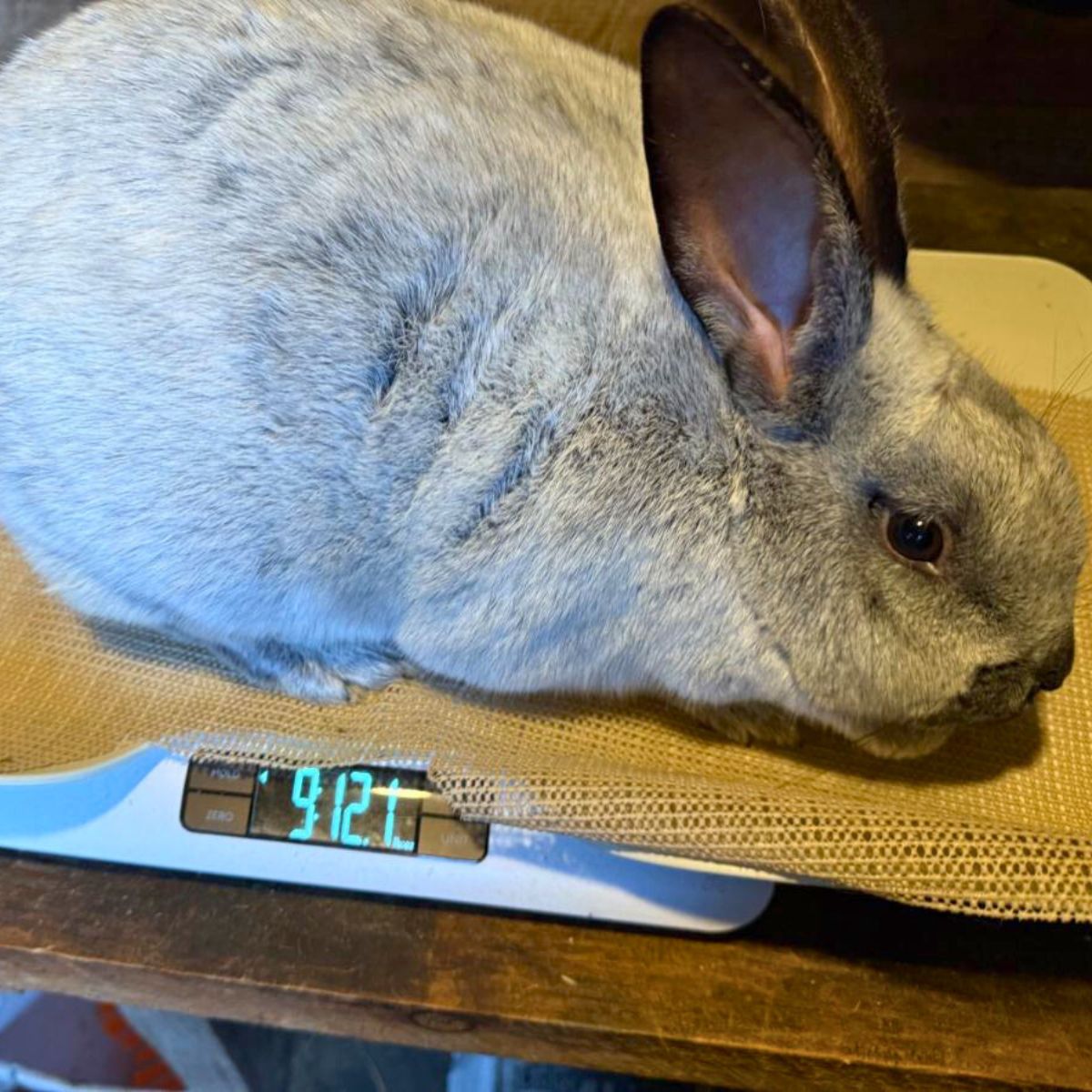
Take some weights. Track several litters. Use this meat rabbit weight tracker. Do the math on the feed that went into your grow outs.
Harvest some young, some in the middle, and some older.
Cook and serve the meat and see what you like best.
Use the information given here to guide you. Consider the different pros, cons, and points.
At the end of the day, the best time to harvest a meat rabbit is when you and yours like the meat the best. When it serves you the best, that’s not something for anyone to dictate to you but yourself.
Do you have experience in harvesting meat rabbits? Questions, thoughts, or concerns? A preferred harvest age? Please share in the comments!

Evelyn Mpolokeng
I would like to to start with rabbit breading what do i need to get first is it the land/space and how big the space should it be.
Mary Ward
Space. You can raise in cages or hutches (in fact I'd recommend it). Once you have a spot picked out, the next step would be cages or housing. Start looking for rabbits while you get your space set up. It can take a bit to find good breeding pairs.