
If you choose to feed hay to your meat rabbits, you’ll want a good way to feed it. For rabbits in cages, you’ll almost certainly want to add a hay rack.

Rabbit keepers are often looking for clean, handy, and economical solutions to things like feeding hay, and this is one.
Here’s a quick tutorial on how to make the same DIY rabbit hay racks that I use in my rabbitry.
Jump to:
- Building vs. Buying Hay Racks for Meat Rabbit Cages
- DIY meat rabbit hay rack options
- Why use hay racks for meat rabbit cages?
- How to Make Fast, Simple, Inexpensive Hay Racks for Your Meat Rabbit Cages
- How to Make the Hay Rack
- Is a bigger basket rack a better idea for singles?
- The average cost of DIY hay racks -- CHEAP!
- Installing the hay rack
- Where to place your hay rack
Building vs. Buying Hay Racks for Meat Rabbit Cages
Of course, you could buy prefabricated hay racks for your meat rabbits’ cages. They do make them.
Many of those racks are perfectly fine. Very nice, even.
They are also very expensive, typically starting at around $10 and going from there.
This might be fine if you’re just housing a single pet rabbit or two, but once your rabbits start multiplying the way rabbits do, and you find yourself with more and more cages, you’ll want a cheaper, easy solution.
Even if you’re only supplying racks to 6 or 10 cages, that $10 dollars adds up. Fast.
The best efficiency and cost-effectiveness in your rabbitry will be to keep your supply costs down as much as you can. When you find a workable, inexpensive way to do that, you’re increasing the efficiency of your whole rabbitry.
DIY meat rabbit hay rack options

There are a few different options for DIY rabbit hay racks. You can make your own out of wire by cutting, bending, forming, and clamping the wire together. It’s not a bad option, but it’s more time-consuming, and a roll of wire isn’t exactly cheap, either. (Though if you have some leftovers from cages or other projects, it’s not a bad way to go.)
The reason I like this particular solution (which I cannot take full credit for -- I first saw it on a meat rabbit group) is that this little hay rack is everything I want in a rabbitry solution.
This simple rack checks all the boxes for being
- Cheap
- Easy
- Fast
- Requires few tools
- Requires no real mechanical skill or inclination
- Leaves no exposed cut wire or sharp edges the rabbits can potentially cut themselves on
- Installs in a matter of a minute (or less)
- It’s cleanable
- Can’t rust
- Is long-lasting
Why use hay racks for meat rabbit cages?

Now, let’s talk about why you would even want to use a hay rack for your meat rabbits’ cages.
If you feed your rabbits hay, it won’t take long before you get frustrated with hay in the cages. Feeding hay in rabbit cages causes some problems:
- Loose hay gets trampled, messed on, and then wasted because the rabbits won’t eat it after that
- Rabbits are apt to make feed hay into bedding
- Hay in the cage will absorb urine and water, which is a good way to make messy animals and, worse, sick rabbits
- Urine-soaked hay invites issues like urine scald if rabbits sit in it
- Coats can become stained (especially light and white colored rabbits); this can make your rabbits look like you don’t clean or care for them and can leave pelts stained, which can be a problem if you want to use or sell pelts
- Seed from hay can fall into dropping pans, which might be an issue if you directly use the waste in garden areas without hot composting (something you can do with rabbit manure because it is cold manure) because it’s putting seed directly on the garden bed
- Loose hay on cage floors blocks wires and lets waste pile up inside the cage
Hay racks reduce hay waste, which in turn reduces feed costs and allows most of the hay to get eaten and used properly.
This particular style of DIY hay rack is easy to fill from the outside of the cage, which makes feeding fast, even if you have a lot of cages to feed.
How to Make Fast, Simple, Inexpensive Hay Racks for Your Meat Rabbit Cages
Supplies: What you’ll need

- Small plastic baskets (look for storage baskets, bins, craft, or pencil boxes)
- Heavy scissors, shears, or nippers for cutting the baskets
- Optional -- a small saw or sawzall, which can cut an entire stack at once (but be careful not to split or crack the baskets)
- Zip ties for installing baskets
This is exactly what I use for the baskets. There are, of course, many similar small baskets that can work just as well. Just look for something that.

- Has basket-style openings on the side, so you can use the “grates” to mount the baskets to the cages
- Is not too thick or stiff, which will make the plastic hard to cut through, and if they’re too rigid, they might break when you cut them
- Is either the right size for a single rack or can be cut in two so you get two out of one basket
The size I use is about an 11x4x8 inch basket.
How to Make the Hay Rack
- Find the middle of the basket, then cut along one edge, then the other, and through the middle, making cuts as clean and straight as you can
- For two racks from one basket, you want to cut across the width of the basket (cut the short way). This leaves you two halves, each of which is now a simple hay rack
- It is easier to cut both sides first so you can reach the middle more easily
To make one large basket
- Hold the basket sideways and only cut the very top of the basket off
- This “top” will be one of the long sides
This gives you a larger rack for grow out cages or cages that may need more hay because they will at times have does with litters in them (though I find the small size usually suffices even for doe’s cages because, by the time they need that much hay, the kits are moving out).
Is a bigger basket rack a better idea for singles?

Bigger isn’t necessarily better for cages that have a single animal in them because then you’re apt to want to fill the rack, and that can result in overfeeding hay. The small 4x4 rack that you get from these baskets is a nice size for a single animal.
Most of my rabbits will eat their pellets first and then eat hay when they’re looking for a little variety. Often, these racks still have some hay in them the next morning.
If you don’t feed pellets and you have a lot of vegetation to feed, though, a large rack might be worth considering.
The average cost of DIY hay racks -- CHEAP!
The average cost of the baskets is between around 1.50 to 3 dollars. That makes each rack about 75 cents, or a large rack usually no more than 2 or 3$, depending on your source for baskets.
This is far more affordable for a large number of cages than 10 to 15 dollars or more.
Installing the hay rack

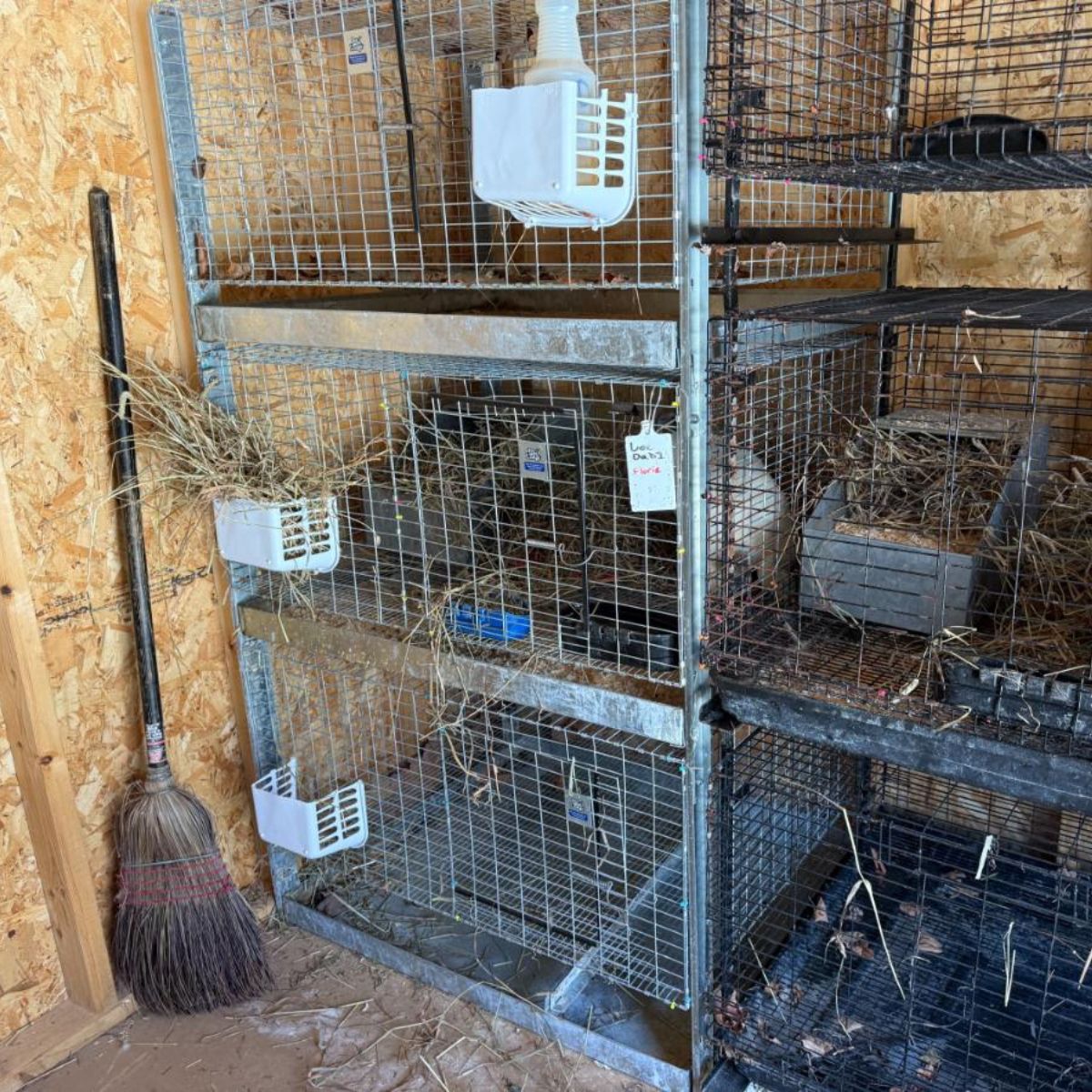
- To install your hay racks, just place them with the wide open side towards the cage wire, on the outside of the cages
- Leave the opening “up”
- Use four or five zip ties to attach the rack to the cage wire -- one tie per corner, and if the bottom seems to gap, add one more in the bottom center
Where to place your hay rack

Put a little thought into where you will put the rack on your rabbits’ cages. Pick a spot that:
- Is out of the way of waterers and feeders
- Ideally, don’t put the rack over a water or feed dish
- This can end up with rabbits stepping in the dish to get to the hay or hay falling into water dishes
- Try not to put the rack in the rabbit’s “poop corner”
- Rabbits usually pick one spot where they’ll make waste -- they’re pretty neat animals; the hay rack is in that corner, and the rabbit pulls hay into the cage and onto the wire; it tends to block the wire so the manure and urine can’t fall down through the cage bottom, and that causes ba lockage, build up, and potentially messy rabbits if they sit in the blocked waste
- This can also lead to problems like urine scald and sore hocks
- Out of the way of doors and openings (make sure all doors, etc., can swing freely and fully as needed)
- Out of the way of things outside the cage that might hit or tear at the rack
- It’s usually better to raise the rack up above the floor of the cage by two or three inches; this is more natural for the rabbit, easier for them to pull from, and less likely for a rabbit to back up to the rack and urinate or defecate on the hay through the wire

Leave a Reply