
Here’s a topic that may seem simple on the surface, but it’s a frequent question in rabbit groups once the weather starts turning colder:
How do you water your meat rabbits in winter?

It’s a good question. It's also one you might not think much about if you started keeping rabbits in a warmer season. If you live in a warm climate, it’s probably mostly a non-issue for you.
But I dare say that most people do contend with at least some freezing weather, and if you do, you need a plan to deal with watering your rabbits in it. Here’s mine.
Jump to:
- What I Use for Rabbit Waterers in the Winter
- What’s good about these cage cups
- Where to find Miller Manufacturing cage cups
- Managing Freezing Water in the Cage Cups
- Other Options for Watering Rabbits in Winter
- Keeping two sets of regular-style water bottles and switching them out:
- Heated water bottles:
- Automatic watering systems with heat tape or heaters:
What I Use for Rabbit Waterers in the Winter

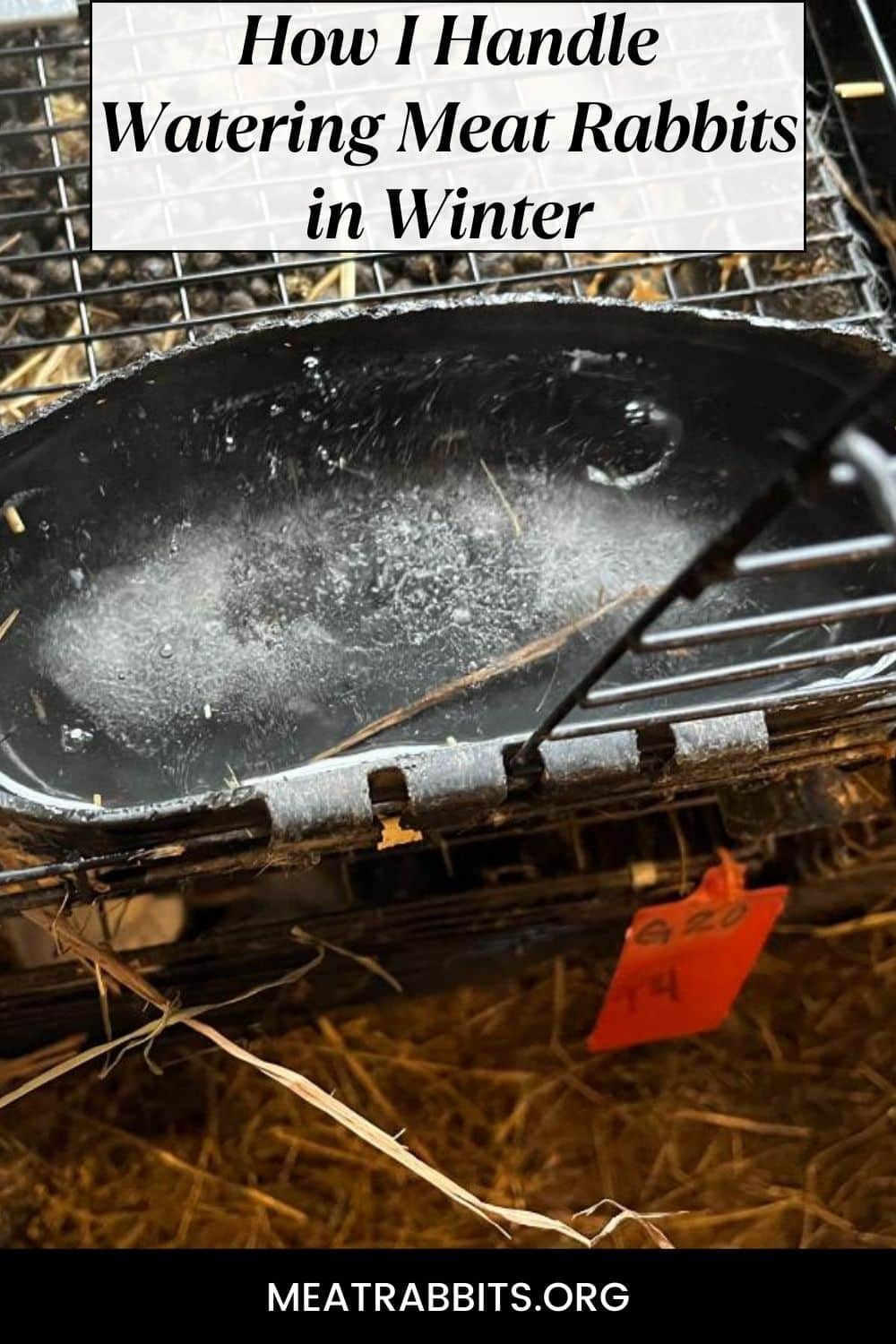
I use the same waterers in winter that I use the rest of the year: One-quart size cage cups from Miller Manufacturing.
Miller Manufacturing sells products under a few different names. I most commonly find these cage cups sold under the brand name Little Giant or Pet Lodge. They will sometimes be listed with Miller Manufacturing as the brand name. But these are all the same products, and I do recommend them.
Miller Manufacturing produces farm and livestock supplies specifically with small to medium-sized farms and homesteads in mind, so their products are often well-designed and geared to backyard livestock growers and farmers. (In other words, they’re better and more affordable than a lot of pet supply companies’ products.)
What’s good about these cage cups
Here’s why I like these cage cups for watering my meat rabbits (all year, but with a focus specifically on winter):
- They are semi-flexible, so they don’t break if you gently flex them to knock out ice
- They hook easily over the wire inside the cage
- They usually stay put (but there are always rabbits that will tug and play and might get lucky and pull them off)
- They're easy to get on and off for quick emptying, cleaning, and refilling
- They stand up to rabbit chewing for a long time
- There is plenty of open surface area, so rabbits can chew or lick to get hydrated even when they freeze
- You have the option of filling them halfway and topping off if they get frozen
- They can’t drip as water bottles can
- Rabbits have no problem learning to drink from cage cups—sipping and drinking from a “pool” is the natural way for them to drink
- Some rabbits don’t take well to water bottles or spigot-style automatic waterers
- Rabbits drink more water from open containers than from bottles
- They require no heaters or extra utility costs
- They can’t break down like a heated system can
- The cups last a long time and don’t break—I'm more likely to need to replace them due to chewing, and even then, they last for a year or more
Miller’s cage cups are sold in a range of sizes. I use the one-quart (32-ounce) cups for water and the one-pint size (16-ounce) for pellets (in my photos and videos the blue cups are the 16-ounce, and the large black are the 32-ounce cups).
I also use 32-ounce dishes for pellets for nursing does and does with kits in the cage, but I prefer to use three or four 16-ounce cups in cages with litters of young kits because the kits jump in the larger cups. They don’t sit in the smaller cage cups as much, so they don’t dirty the pellets as much in the small dishes.
Where to find Miller Manufacturing cage cups

I am able to buy these dishes at my local farm and feed store, but they are also available online from various retailers. You can learn about them from the Miller Manufacturing site, but they do not sell directly to customers.
Here are some places I have found these cage cups online:
- Valley Vet Supply
- Circle C Country Supply (seems to have the best variety and size selection and the best prices)
- Amazon
There are similar designs of cage cups from other brands, some of which I’ve tried. They’re cheaper, but the plastic is softer and thinner, and the rabbits chew them and ruin them much faster. I use them because I have them, but I will not buy them again—I'll stick with the Miller products.
If Miller is not available to you, though, there are other similar styles of cage cups out there that will work well for winter watering.
Managing Freezing Water in the Cage Cups

The advantage of using cage cups is that even if they freeze, the rabbits have some access to hydration. It is not ideal, but in a frozen bottle, they have absolutely none. (That said, the cups do get filled with open water every morning and topped off in the evening if the day has stayed cold and refrozen the dishes).
I’ll often take a bucket of hot water out and dip the cage cups in the hot water, then pop the chunk of ice into an empty bucket and refill the cups from a second bucket.
Whenever there is less than half a dish of open space to put in fresh, open water, the dish gets dunked and emptied.

If freezing is light and there is room in the dish, I’ll often top it with hot water, which will melt through a light top layer of ice and melt through some of a solid ice chunk.

Meat rabbits seem to prefer cool or cold water for drinking (they’ll often wait to let hot or warm water cool down), so hot water to melt onto ice that cools it is often a good happy medium.
All water cups are emptied completely at least a couple of times a week.
Other Options for Watering Rabbits in Winter

There are other products that meat rabbit breeders use. Using open-cage cups is the method that works for me. I use them all year round, summer included (because again, I find—and other breeders support this—that rabbits drink best from an open water source).
Some other products and methods you might consider (with a few notes on pros and cons as I see or have experienced them) are these:
Keeping two sets of regular-style water bottles and switching them out:
- This requires investing in double the amount of waterers for your rabbitry.
- One set comes inside while the other goes out to thaw for the next day.
- I find that in any serious cold, the metal nipples freeze quickly and that limits the availability of water in any form at all, and the rabbits have access to the open water for a much shorter window of time.
- On cold days, their drinking option may only be limited to a half hour or hour after you switch the bottles.
- In my experience, this is labor intensive, and all those bottles can take up a lot of room.
- Since the bottles obviously need a warm space to thaw, that’s a decent amount of space in a sink or tote for most of the winter, and it’ll have to be inside where there is heat. For most of us, that’s in our house somewhere.
- Once the bottles have frozen into an ice block, it can take a long time for them to thaw. In a cool room, they may even be too frozen the next morning.
- If you have to hand thaw the bottles, that takes a lot of time with a lot of soaking or running hot water. (Like I said—labor intensive.)
Heated water bottles:

- These are similar to traditional water bottles, but they plug in and are heated to prevent freezing.
- Read the description—not all heated water bottles are rated for outdoor use!
- The units are expensive, and meat rabbit breeders often have many cages to cover. These cost in the range of $30 USD. That is a large expense in just the bottles alone.
- You must make sure cords are inaccessible to all rabbits (so not hanging down where a rabbit can pull it in or chew it). For some reason, rabbits love to chew electrical cords! (Speaking from experience with a free-roaming pet rabbit in the house years ago. It didn’t roam free for long after we had to splice every TV and game station cord in the place).
- The electricity to run the bottles is expensive, too, and you’ll need to house your rabbits near electrical access.
- For me, this would add too much to the expense of my utility bill and would undercut the cost efficiency of keeping meat rabbits. (My electric bill is high enough!)
- Though it’s probably a sporadic issue, power outages would be a concern.
- If you use them, check daily to be sure the units are working and that water is flowing freely.
There are also bowls and crock-style heated units that can be used for rabbits. I’d be concerned about them being pulled and tossed in the cage, so if you look into them, pay attention to how they mount and what keeps them secure. Again, the issue of chewed wires is a real concern.
Heated bowls might work well for a free-roaming or colony-style setup. For a multiple-rabbit setup like that, heated poultry waterers can work, too, if the safety and utility issues are addressed and are acceptable.
Automatic watering systems with heat tape or heaters:

Automatic watering systems have the great advantage of not needing much (if any) daily management. Some concerns with them:
- They’re expensive and time-consuming to set up and require some handy-man and at least entry-level plumbing skills
- You do need to check every day to make sure they are still working
- Freezing anywhere in the line can cut off water to many or all units
- Power outages that cut off the heat can split hoses or piping
- Burst piping may leave water spraying in buildings or on animals or may spray on animals when the lines thaw and start to run again
- Leaking and spraying lines can result in wasted water and pumps running for hours before you find them
- It can be difficult to keep the nipples and the system from freezing
- Requires electricity and increases utility costs
- Repairs can be difficult to address in winter
- If they fail or freeze, there is no form of water available to the rabbits at all until replaced or repaired
I wouldn’t say any of these are bad ways to handle winter rabbit water, and there are surely rabbit raisers who report good success with these other methods and setups. But I can say there is a reason I don’t do it this way!
My main reasons? Expense and the work of setup and added utilities, along with (in the case of switching water bottles daily) additional workload and no access to any form of water once the water freezes. At other times of the year, the fact that rabbits drink more from crocks goes a long way, too.
I hope this gives you a simple solution for watering your meat rabbits through the winter. After trial and error, it’s the system that I’ve found is the most efficient, affordable, and manageable for me.


Leave a Reply