
Retiring meat rabbit breeding stock is something that comes along later down the line. When you’re just starting out, you probably won't give this topic much thought. But as the years start to pass by, you will reach a point where you realize that rabbit retirement for your breeders is a real and true issue. It’s one that you’ll need to make some decisions about and make a plan for.

Before you need to decide what to do with retired meat rabbits, you’ll need to decide when to retire them and move them from the breeding program.
Jump to:
- More Often than Not, You’ll Need to Decide When to Retire Breeding Meat Rabbits
- Retirement by Age
- Retirement According to Production
- Retirement By Performance
- VIDEO: How To Decide When It’s Time to Retire Your Meat Rabbit Breeders
- Retirement by Body Condition
- Retirement to Refresh Rabbitry Genetics
- Retirement for Other Reasons
- Selection and Retirement Maintain Rabbitry Production and Efficiency
More Often than Not, You’ll Need to Decide When to Retire Breeding Meat Rabbits
It is possible that your meat rabbit breeders will remain productive up until they die of natural causes. (This is probably more true for bucks than does.) However, most of the time it will be up to you to decide to retire breeders before they reach that point.
For the health, productivity, and efficiency of your rabbitry, you’ll have a better, stronger, more productive program if you retire meat rabbit breeders rather than waiting for them to pass away from natural causes.
Why is this in your best interest?
- Older breeders produce fewer offspring
- They may have difficulties breeding or lack body condition and energy for strong reproduction
- It costs just as much (and sometimes more) money to keep low producers as it does high and efficient producers
- Animals in declining condition are more likely to fall victim to health, illness, and immune conditions (some of which they may pass on to younger, healthier animals)
- You will keep the best growth rates and most productive grow outs overall if you keep strong, healthy, efficient, and productive breeders
This tells you why you should be diligent in retiring your meat rabbits, but let’s look at when you should do that. What are some times, signs, and signals that warrant retiring one or more of your breeder rabbits?
Retirement by Age

Retiring meat rabbit breeders on the basis of age is a good, efficient way to manage your rabbitry. It is also less subjective ,meaning that you won’t be left with questions or trying to make educated guesses about whether or not a breeder is truly in need of retirement.
Retiring by age alone allows you to easily plan for holding or buying replacement breeding stock.
If you are planning to retire your meat rabbit breeders based solely on age, retire them between two and three years old.
Remember that it takes six to eight months for a breeder to come of age to begin breeding, so if you are retiring a breeder, you will want to start raising their replacements about half a year before you plan to retire them. (However, replacements can also come from current grow out litters if you have strong candidates from those litters, so that time may be less.)
Retirement According to Production
One of the more common approaches to retiring meat rabbit breeders is to retire them when their production begins to drop off. This is most often gauged by:
- Litter size -- the number of kits in their litters drops lower; if lower than six on most litters, replace the breeder. You might also replace a breeder if the litters are usually large (8 to 12) and they consistently start producing smaller litters of half or less -- this is all about the production numbers and litter size you personally want to see.
- Missed breedings -- if you are continually exposing breeders and the doe is not getting bred, someone needs to be replaced. This is especially true if you see fall offs but have no pregnancies. In this case, the doe is usually the rabbit in need of replacement, but a buck could be sterile or impotent, too.
Keep in mind that production (or lack thereof) can come from either the doe, the buck, or both. Time of year and factors like heat and fertility can also come into play. So, you may need to give a breeder another chance or two, or perhaps cross different pairs to figure out whose production is declining. (And again, it could be both if they are of similar ages.)
Retirement By Performance

Performance (or more accurately, poor performance) is a prime reason to retire a breeding meat rabbit.
When we talk about retiring a rabbit according to its performance, we are talking about things like low or slow growth rate of grow outs and other negative traits and characteristics that should be removed from your rabbitry.
Retiring or culling according to performance is important for the most productive, efficient, healthy meat program. Keep in mind, retiring breeders due to a lack of performance can and should be done at any age.
Sometimes, you’ll have a breeder that is quite young and who you’ve had high hopes for, but it just doesn’t work out.
There’s no use keeping a breeder that is hurting your production and rabbitry health or success. The sooner you remove the problem, the sooner you can replace the problem with better stock, and the sooner you can begin to see improvement.
As they say, it costs just as much to feed poor livestock as it does quality livestock. When you add in expenses related to health and wellness issues, they’re really more expensive!
Performance issues that warrant retiring a breeder (even a young breeder)
- Poor growth rates in grow outs
- Small, poorly muscled meat carcasses
- High bone to meat ratios (meaning less edible meat and a lot of the weight going into the skeleton and bone structure)
- Recurring or chronic illness in the breeder
- Recurring or chronic illness in the offspring (grow outs); for example, enteritis or diarrhea regularly occurring in different litters with no other logical or pathological cause; GI stasis frequently in different litters
- Congenital defects like megacolon
- Frequent issues, even if they aren’t chronic, that impact the wellness and growth rate of the grow out offspring
- Dental issues or problems with teeth, such as malocclusion (overgrowth of teeth or curling, long teeth), tooth or gum abscesses or infections, or jaw problems that prevent rabbits from eating
- Skeletal issues like weak legs, poor alignment, or deformity
Health issues like these that relate to a weak constitution, congenital defects, or genetics passed from the parents will not improve and will not disappear. The way to deal with them is to cull and replace the offending breeder or breeders.
VIDEO: How To Decide When It’s Time to Retire Your Meat Rabbit Breeders
Retirement by Body Condition

As breeding rabbits age, their body condition will begin to deteriorate. This is not unlike the loss of muscle and skin condition that we experience -- or any other animal for that matter. This is the simple influence of time, life, and living.
Rabbits are prey animals with relatively short lives so this may happen sooner than you might expect it to. It can vary among breeding stock. It is also something that is impacted by the breeding schedule you keep.
Rabbits in an intensive breeding schedule of every four to six weeks or less are expected to have a toll taken on their body condition and on their ability to rebound between breedings more quickly. In other words, they’ll lose their condition at a younger age.
On the other hand, rabbits that are not bred on a regular basis will have poor condition, too, and the lack of doing what rabbits are designed to do (breed and reproduce) is also a cause of poor condition. Fat, overweight rabbits have difficulty breeding and conceiving.
Simply put, the answer is not to breed less. It is to manage your breeding herd well and in a regular, productive fashion.
Continuous, efficient meat production is your goal!
Body condition factors to look for
Look for signs like these when determining body condition and whether or not to retire a meat rabbit breeder:
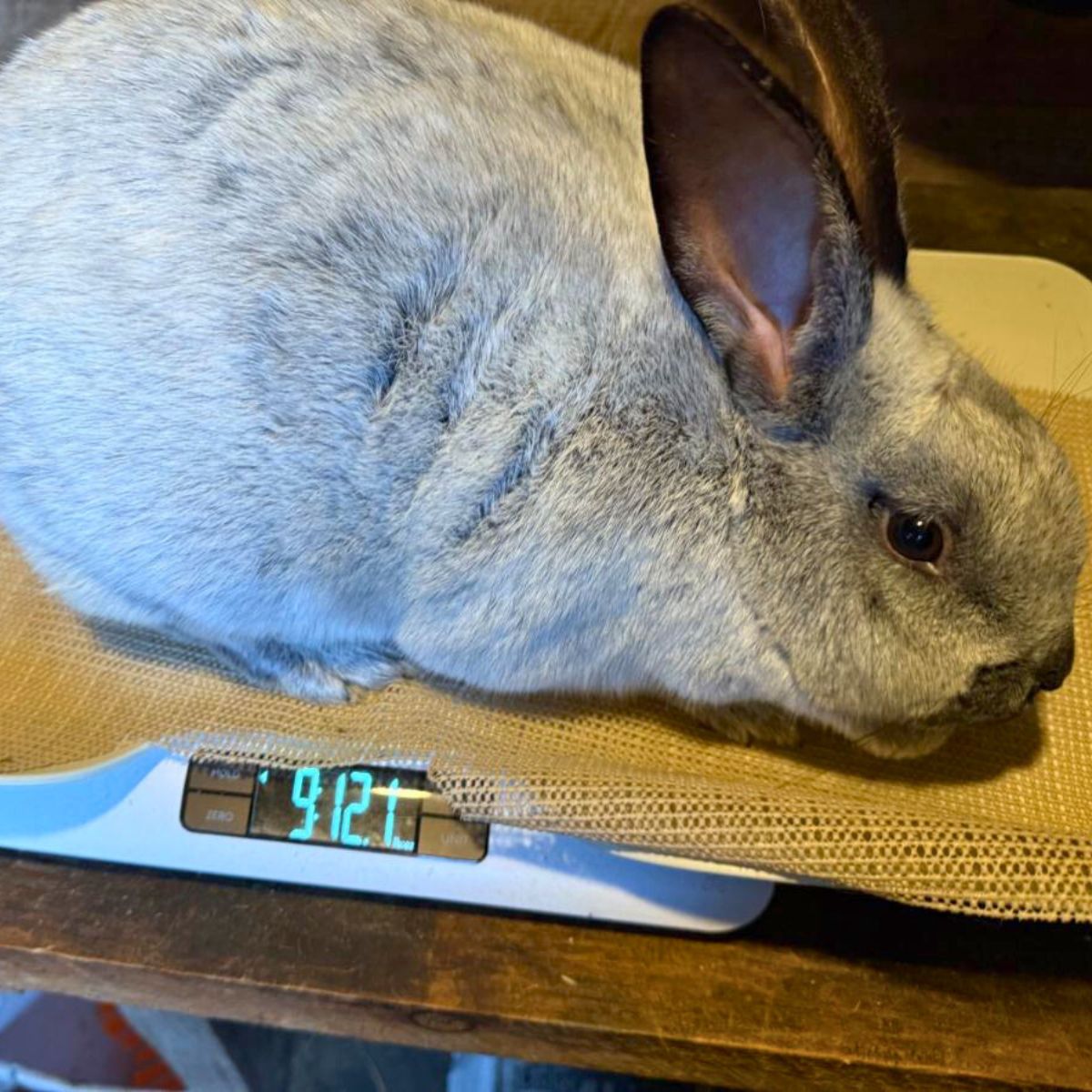
- Weight loss
- Inability to maintain a good weight during pregnancy
- Inability to maintain a good weight while nursing
- Inability to rebound and regain weight lost during pregnancy and nursing after kits have been weaned (Is it taking longer and longer to recondition a doe after raising a litter to weaning age?)
- Lazy, tired, or lackadaisical does or bucks
- Rough coat
- Overweight does or bucks
- Does that don’t get pregnant or don’t deliver kits even with fall-offs
- Disinterested bucks
- Does that won’t lift for bucks
Weakened by age can ripple out into younger rabbit stock, too

Also, remember that older, weakened animals are more prone to immune system breakdown, which means they are more likely to get sick just because they aren’t as young or as strong as they once were. And while that may be a fact of life that doesn’t directly impact the health of the other rabbits in your barn, it may get to a point where it does.
Older rabbits that are more likely to get sick can get sick with things that are contagious, and may increase the likelihood of illness and diseases or parasites like coccidiosis being passed among all the rabbits. The stronger the herd immunity, the stronger your herd!
Retirement to Refresh Rabbitry Genetics
Sometimes, retiring and replacing a breeder is the right thing to do simply because you need to breathe new genetic life into your rabbitry.
There may not be a lot of obvious signs of poor or reduced performance or productivity, but it may be that your herd is getting to the point where there is little genetic diversity left, and it’s time to introduce something new in the interest of keeping your rabbitry going.
This is another instance in which you may decide to replace a breeder before its productive time is up. …Or, you may just time things right so that when the long-term breeders are nearing an end to their productive lives (or you think they soon will be), you buy in a new doe or buck or two to freshen the pool of genetics and favorable traits.
Retirement for Other Reasons

There are other reasons that you may decide to retire and replace breeding stock. This would be if you had a specific goal in mind, or an experiment, trait, or characteristic you want to introduce.
This is often the case for people who show their rabbits, or who are working to improve their breeding stock for sale (especially, but not limited to, people who show or sell to a mix of meat and show buyers).
This is related to genetics, because if their genetics are not there to achieve your specific goals, the only way to get them is to bring them in. And since we can’t keep all the rabbits in the world, your most efficient and cost-effective means of doing this is to replace rabbits that don’t have what you need with some that do (or at least, you think they probably do).
Some examples of when you might replace and retire for other reasons include:
- Breeding toward a specific rate of growth in the grow outs
- Breeding for rabbits that do well on a specific diet (for example, a forage or hay and pellet diet, or a lower protein diet)
- Breeding to achieve the closest Standard of Perfection (SOP) for the breeds you are keeping
- Breeding for color traits
- Breeding toward a specific bone-to-meat ratio, or distribution of muscling
Selection and Retirement Maintain Rabbitry Production and Efficiency
Though we often hate to see our favorite breeders go, for the sake of the rabbitry and the overall health, cost effectiveness, and continued good production of your fluffle, you need to make the right decisions regarding meat rabbit breeder retirement and replacement.
That is easier to do when you go at it armed with the knowledge that helps you to make good decisions. Then, you’ll feel confident about your choice, knowing that you are doing it responsibly and for the sake of your meat rabbits.

Leave a Reply