
Cage tags are a simple, at-a-glance way to keep track of rabbits in the rabbit barn or rabbit room. They only take a few seconds to attach.

Once you’ve established a simple system of coding and identification, recording information for your data and records becomes easy. I promise creating codes and identifications is simple, too.
Jump to:
What I Use for Cage Tags

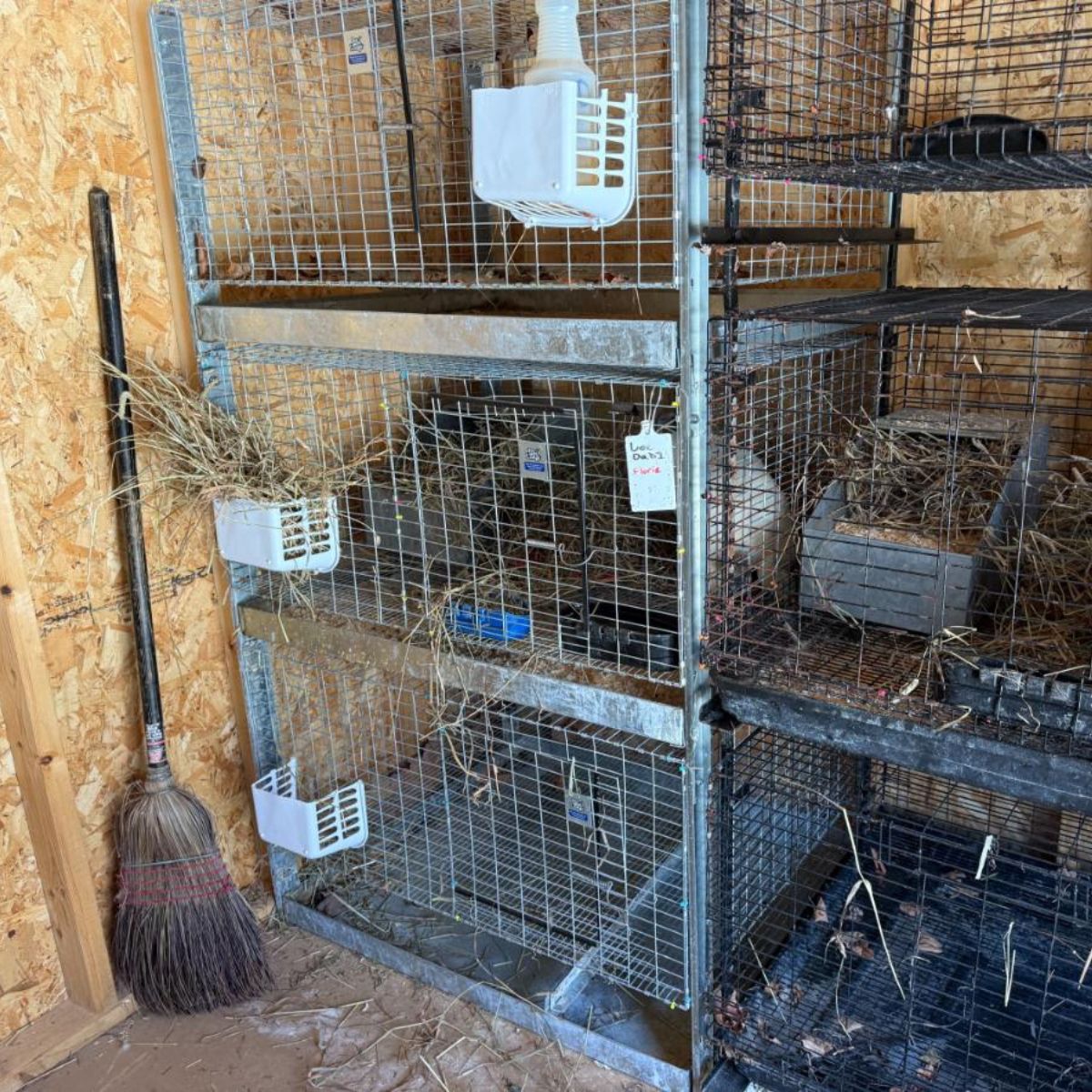
I use a system of cheap, reusable plastic tags in the rabbitry that lets me identify the rabbits and know some basic information with just a quick look at the tags. They last a long time, are cleanable, and are easy to replace if one gets too chewed (which happens from time to time).
I prefer cage tags to cage cards because they don’t absorb urine, water, and mess, and they don’t need a protective sleeve. I use them for quick reference but keep more substantial records separate on clipboards in the rabbit room. That way, I don’t have to worry about losing valuable information on cards kept on the outside of the cages. Because I promise you, somehow, there will always be one or two rabbits that figure out how to nibble the cards and sometimes even lose them completely.
These are the tags I use, available for not much money from Amazon. (At the time of this writing, about $13 USD for 60 tags).
*Cow ear tags work well, too, but they were surprisingly expensive when I went to buy them. I haven’t looked at the price of cow tags since my days on my parents’ dairy farm. Wow, were they pricey! And really, it's not much different from these tags. I do think cow ear tags would be really permanent, and we used to melt numbers into them, then trace them over with the ink, which made the ink last a really long time. But for the money, these work just as well!
Writing and recording on cage tags and reusing tags
Permanent markers and dry-erase markers both work well on these plastic cage tags.
- I use permanent (“Sharpie”) markers for permanent information such as cage numbers
- Breeders’ tags are usually done completely in permanent marker because they need to last a long time and don’t need to be updated or reused, so when a doe or buck is gone, I just replace the tag completely
- I will often put a second tag on a doe’s cage when she has a litter, which has the litter number on it
- Dry-erase markers are used for litter ID numbers on the grow out cages
- When the grow out is harvested (or sold or moved to be a breeder), I can wipe off the last resident’s information and replace it with the new tenant’s details

- Alcohol on a rag or cotton ball or alcohol wipes will easily wipe off old dry-erase marker if it is stuck on, and with a little elbow grease, they wipe off most permanent marker, too, if necessary
- The tags are cheap and reusable over and over, as long as a crafty kit doesn’t grab it and chew it too much
- The tags come with a “zip tie” feature for easy application; sometimes, a rabbit will chew it off, or I may need to cut it to move the rabbit and its tag

- When this happens, I use metal shower curtain rings (without the balls) to attach the tag through the original tie hole
Cage Tags for Meat Rabbit Grow Outs

Tags for grow out cages are usually pretty basic and simple. They are used as a means of identifying, keeping track of litters and ages, and weight tracking more than anything.
Information typically listed on grow out cage tags:
- Cage number
- Litter ID
- If sexed, the sex of the rabbit
Cage Tags for Breeding Stock

Breeders get named, so that is the first and most identifying feature on their cage tag.
I do include a few other details on the cage tag just because it makes it easy to jog a memory or quickly see a piece of information I might want, without having to dive deep into paper records (or even online records, if I used apps, which I don’t…because I just prefer paper for this).
Information typically listed on breeder’s cage tags:
- Doe or Buck’s name
- Year of birth/birth date
- Date they will turn 6 months old (date they can start breeding)
- Ear tattoo of a tattooed rabbit
- If originally from another rabbitry, the place of origin (which gives me a quick idea of possible relationship to other rabbits or breeding lines they came from)
Of course, a lot of this information exists elsewhere in my written records, but this ensures that all rabbits are easily identifiable at a quick glance and gives me the most pertinent information I might want for management purposes.
The most important information for the breeders is the name/identity.
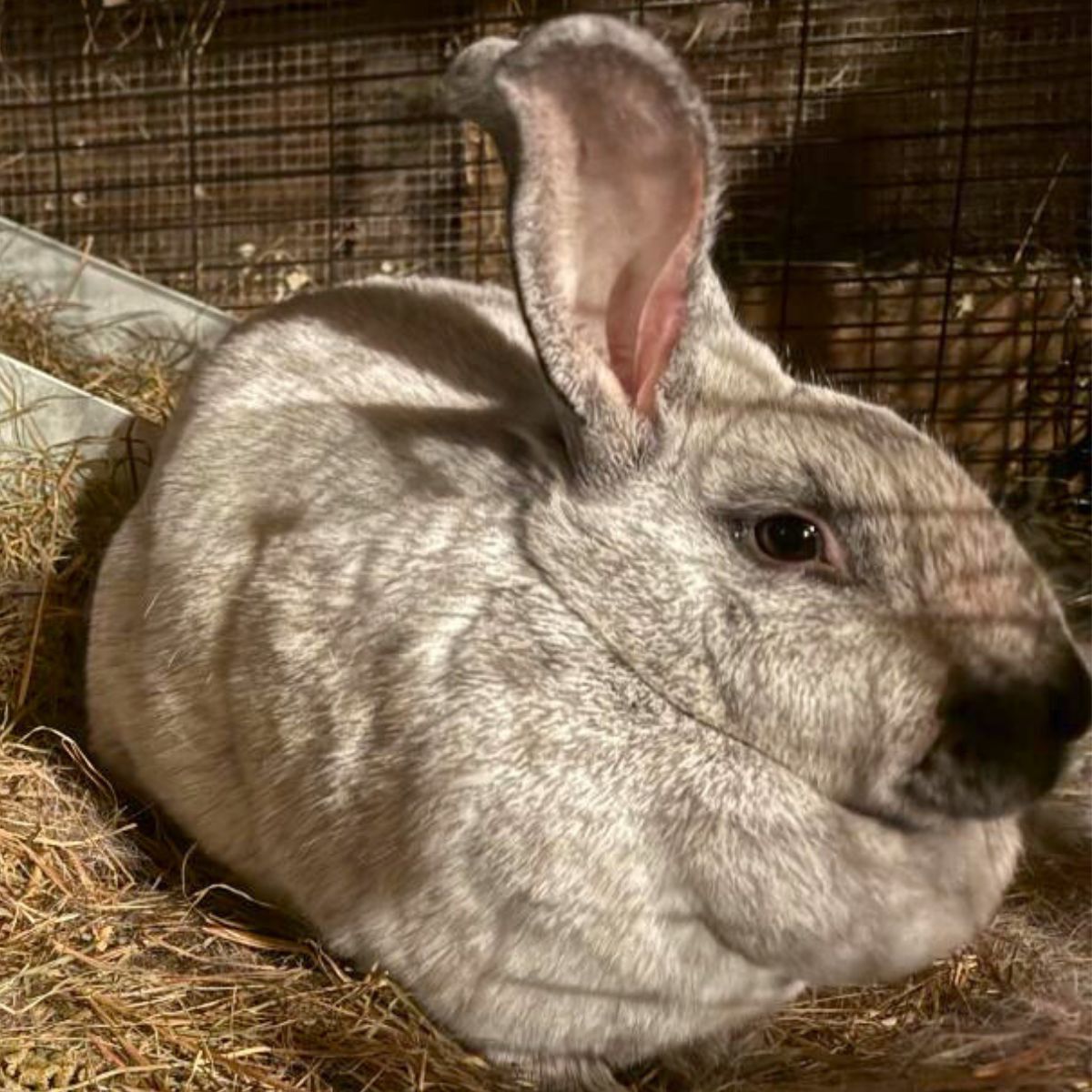
Having the rabbit’s tattoo number on the tag, if it has one, helps just in case I need to double check the number to make sure the right rabbit gets into the right cage. This is a pretty new necessity for me. Up until now, most of my rabbits have been easily distinguishable, but the champagnes all look very much alike, including the does and bucks and this is a good, quick way to make sure the right rabbit gets back to its rightful home.
Creating Easy, Informative, Meaningful ID Codes

I keep my identification codes simple, but meaningful. By following the same basic format for codes, I can tell all the essential information about a rabbit, kit, or litter just from the code.
For Litter ID Codes:
- First letter is the Doe’s first initial
- The second letter is the Buck’s first initial
- The number at the end is the number of litters the doe has had (all time)
So, for example, if the litter is from Holly and Winston, the Litter ID code would be this:
- Holly=H
- Winston=W
- Holly has had 10 litters before this litter; this is her 11th
- The litter ID code is: HW11
From this, I can always tell just by looking at the litter number:
- Who the dam (mother) is
- Who the sire (father) is
- How many litters the dam has had since I’ve owned her
- If two kits from different litters have the same parents or a parent in common
- For example, a kit from litter PS2 and PS5 both have Peony and Sunny as parents, making them essentially genetic siblings, even though they are not littermates
- A kit from PS2 and a kit from TS4 have different mothers (Peony and Tippy), but have the same father (Sunny)
- A kit from PS2 and RT2 are not related at all because they come from Peony x Sunny and Rose x Toussaint, respectively
This tells me important things for the future that help me decide if it is appropriate or worthwhile to breed two breeders together or if I should keep rabbits from a litter as replacements for future breeding (because I wouldn’t want to hold something back as a breeder if I only had a sibling to breed it with, for example).
- In the example above, I know that I can breed a PS2 rabbit with an RT2 rabbit without worrying about anybody being too closely related
- (For this example, we’re not going to get into discussions of line breeding and what is or isn’t too close to breed…that’s a topic for another day!).
From litter ID code to tattoo
I do not tattoo my rabbits because I do not generally pedigree or show them and they are primarily used for meat, which means a short life and not worth my time to tattoo. However, this might need to change with the Champagnes if buyers are requesting pedigrees or intending to show the animals. My champagnes did come with pedigrees and tattoos.
Either way, it would be easy to turn a litter code into a tattoo identification. I would simply use the same litter ID and then add a consecutive number for each litter member that is getting tattooed.
Example:
- Holly and Winston’s litter is HW11
- The first kit’s tattoo would be HW111
- After that they would be HW112, HW113, HW114, and so on
For Cage Numbers:

- G is for grow out cages
- The number is simply a number, assigned by consecutive counting, from 1 through 20 (because I have 20 grow out cages)
- So, grow out cages are numbered G1, G2, G3, and so on up to G20
- T is for Transition cages
- There are three transition cages, Numbered T1, T2, and T3
- D is for doe’s cages (D1 through D9)
- B is for bucks’ cages (B1 through B4)
The cages are numbered in order, but it has also happened that cages get moved around, and they might fall out of order. This doesn’t matter, really. The purpose of the cage number is to have a way to identify the rabbit to match to records, such as when I weigh and track the rabbits. The cages and numbers are reused with different litters of grow outs.
If I decide to keep a grow out for some reason, it would be moved to a more permanent cage with a permanent cage number and a name. (For example, I might do this if I decide to keep a rabbit as a replacement breeder -- the most common reason I’d hold an animal other than if I’m holding one for sale to someone.)
Transition cages

Transition cages are large cages that I will put entire litters into when they are weaned. At weaning, those rabbits could also go into individual cages or get sorted into two large cages by sex. Either way, I will do this in eight weeks.
There is no reason that I have to use a transition cage. It’s just a time and space saver, and it cuts down a little on chores and cleaning for a couple more weeks until they get sorted and situated permanently until harvest. I happen to have these cages, so I use them, but they are not strictly necessary for your rabbitry.
The transition cages also help me to cycle litters through the cages without having to add more cages. I can often keep a litter in a transition cage for a few weeks until I can harvest an older litter and space opens up a bit more. Sometimes, rabbits may stay together in the transition cages until harvest, depending on space and how many of the same sex are in a litter.
A Steady Flow of Rabbits and Relevant Information At A Glance

Having a simple system like this and a sensible rotation of cages helps to keep things moving along.
I have the pertinent information without having to dive through files, and a system of cage rotation that keeps ages and stages moving through without crowding does, while being able to rebreed on a good schedule and without having to invest in cages that aren’t needed for much of the time.
It’s a system that can work inside or out and still keep you in the know with litters of varying ages and stages.

Bonus Backlinks
Appreciate it for sharing the information with us.