
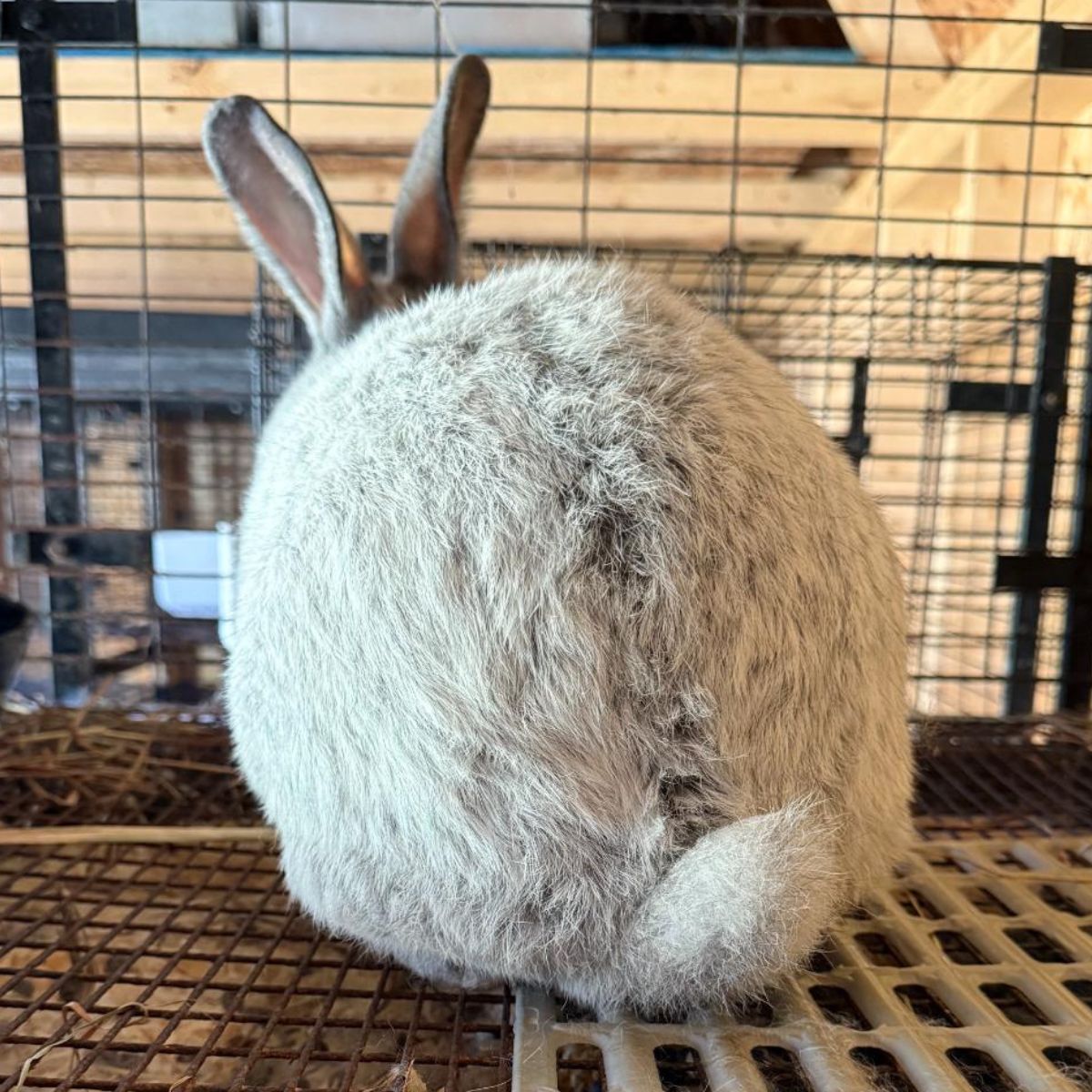
At some point in your meat rabbit journey, you will come up against the issue of retiree meat rabbits. These are breeding stock rabbits that fall off in production or cannot hold their condition and will need to be retired from your breeding program.

Depending on your breeding schedule and other factors, you can expect this to come between two and five years of age.
The question becomes -- what should you do with them?
What options do you have for meat rabbits that are no longer productive enough or no longer in good enough condition to continue breeding, but that don’t pass away from natural causes (forcing you to make a decision and do something with them).
Want to read more about the lifespan and productivity of meat rabbit breeding stock? Read here.
Jump to:
- What Makes Breeder Disposition Different
- The Efficient Choice: Culling Unproductive Breeders
- Harvesting and Using Retired Meat Rabbit Breeders
- Alternative Options for Retired Meat Rabbits
- VIDEO: What Can You Do with Retired Meat Rabbit Breeders? Options and Alternatives.
- The Decision is, Ultimately, Yours to Make (But We Can’t Keep Them All)
What Makes Breeder Disposition Different
What makes this a question is that breeders are in a sort of in-between category as opposed to meat rabbit grow outs. The grow outs were bred for the express purpose of harvesting them and eating them. They’re not around for long.
You don’t grow attached to grow outs because you don't allow yourself to. Grow outs do not stay on the farm for more than three or four months, and often less.
With breeding stock, it’s a bit of a different situation. You may or may not like them for meat. You’re more likely to give them names, if for no other reason than the fact that you need to be able to identify them and identify them as the parents of different litters. If only for record-keeping purposes, you’re apt to give your breeders names.
Meat rabbit breeders are also a part of your barn for a much longer span of time. If there is not a good reason to replace a breeder, it should be a part of your life for at least two years, and more commonly for back yard and homestead type operations, for three to five.
This makes breeders something of an in-between. They are not exactly pets, but they are no longer productive animals, either. You might think of them as something of a semi-pet. On the other hand, feeding unproductive animals will erode the cost-effectiveness of your rabbitry. So you might decide you want to explore other options for them.
Let’s look at a range of options that spans the gamut.
The Efficient Choice: Culling Unproductive Breeders

If we are talking straight efficiency, the right answer is to cull retired breeders from your program as soon as you decide not to breed them anymore.
Culling means to remove an animal from your barn or farm entirely. It may refer to dispatching, but it can also refer to shipping an animal out or away in one way or another.
This is the most cost-effective solution. It is also the most straightforward and sensible solution from a management perspective. By culling retired breeders, you
- No longer incur feed expenses
- Remove other expenses like bedding, supplements, and healthcare items (all of which may be likely to increase as a rabbit ages and its immune system and body begin to age and break down)
- Remove your time expenditure for that animal
- Reduce housing for that rabbit and open up space for younger, more productive animals
On the basis of strict logic, taking the emotion out of it, this is what we should all do.
BUT…if you decide you want a different fate for your breeders, there are options.
In the strictest sense of the word, to cull means to dispatch the animal (end its life) and dispose of it properly. But culling can also mean to ship out an animal or find an alternative for it.
There are culling options that do not require dispatch, but which will still allow you to cull them while preserving the cost efficiency of your rabbitry, along with space and management efficiencies, too.
Harvesting and Using Retired Meat Rabbit Breeders
The highest and best use for a culled breeder would probably be to harvest it and eat it. Many people don’t do this because the goal for rabbit meat is normally to harvest a young, tender animal.
As with all animals, the older the meat rabbit is, the tougher it will be. The flavor will tend to be stronger. You’re likely to find more fat on the animal, too (though with rabbits, this is bound to be to a lesser degree).
It’s important to know this: if you want to eat an older rabbit, you can.
There is nothing wrong with the meat on an older meat rabbit, such as a retired breeder, as long as it is in good health and fair condition.
Just because a rabbit isn’t producing sizable enough litters anymore does not mean that its meat is bad. It may not even mean that its body condition is poor. In fact, sometimes breeders get retired when they are in quite good body condition, especially if they are larger and fatter. As we know, fat reduces reproduction, and that's the top reason to retire a breeder.
If you want the most use out of your rabbitry, and the animal is healthy and in good condition, consider culling it and eating it -- harvesting, really.
Preparing and cooking older meat rabbits
Older rabbits can still be made tender by cooking at a low and slow temperature. Slow roast at a low temperature in the oven or in a crock pot, and you may never notice a difference.
Older rabbits also make very good ground rabbit meat and sausage, and you’ll likely never notice the difference. Texture will not be an issue in older ground rabbit meat (but some people do say it tastes stronger; I've not experienced this to an appreciable degree of difference).
To sum up, some options for eating older retired meat rabbits:
- Debone the rabbit and grind the meat
- Cut the meat into stew meat and cook it low and slow as you would any other type of stew meat
- Make rabbit sausage (which will overcome issues of both texture and stronger flavor)
- Slow roast the rabbit in the oven
- Make shredded rabbit meat
- Slow cook the rabbit with moisture in a crock pot or slow cooker
- Use the meat in a more heavily spiced or flavored dish
Alternative Options for Retired Meat Rabbits

If you just don’t have the heart to dispatch or harvest an animal that you’ve come to think of in more friendly terms than most, here are some alternative placements and solutions that might work better for you.
Placing Retired Meat Rabbit Breeders as Pets
You could find a home for your retired breeder as a pet. If you do this, you should advise the new placement that the rabbit is too old to breed and be clear that it is intended as a pet only.
Many meat rabbit breeders do not like this option. In fact, I’ve seen breeders who refuse to even sell a live young meat rabbit as a pet. It is understandable why, too. There is often (not always, but often) a lack of respect for meat rabbit breeders, and it may be difficult to see eye to eye on the different uses of rabbits between production and pet keepers.
Another reason that meat rabbit breeders sometimes refuse to sell, give, or place meat rabbits as pets is that pet rabbits often become forgotten and neglected. Owners get bored with them. Sometimes, they expect the breeder to take it back when they are done with the animal. It is not uncommon for a bored or neglected rabbit to be in poor health or condition, especially if the owner didn’t know what they were getting into or didn’t know enough about rabbit health and nutrition.
Pet rabbits often get fed inferior feeds that look more like tasty cereal treats than good quality, balanced rations. They may be fat or they may have chronic digestive issues.
Another problem with accepting rabbits back that were placed as pets is that you are opening your barn to potential illness, parasites, and diseases. This won’t always be the case, but it is a chance you’d be taking. (For certain, any new or returning animals should be placed in quarantine for at least 30 days.)
Of course, there are no absolute,s and many pet rabbits are kept happily and healthily their whole life long. But many are not, and I understand why some breeders do not allow their animals to come and go through their barn this way.
VIDEO: What Can You Do with Retired Meat Rabbit Breeders? Options and Alternatives.
Rescues are not a Dumping Ground for Retired Meat Rabbit Breeders
Please do not place retired meat rabbit breeders with rescue organizations.
These organizations are more than overrun with forgotten and neglected pets whose owners got bored of them. Doing this also gives a bad name to meat rabbit breeders.
To be clear, I do not know of meat rabbit breeders who typically do this, but there seems to be some belief in the rescue industry that meat rabbit breeders are where so many rabbit rescuees come from.
I’m quite positive that overall, it’s an erroneous belief. More likely, they come from pet owners who don’t know how to sex rabbits and keep males and females together, or don’t know how young rabbits can breed and reproduce, and keep them together for too long, or from pet owners who grow bored of their rabbits. Some probably do come from some intended meat rabbit breeders who can’t see the task through or get overrun. But by and large, it’s doubtful that meat rabbit breeders are the bulk of the problem.
Regardless, we see enough of this accusation on farm pages and online forums from people who hate meat rabbit breeders. Let’s not fuel those flames.
Sending Retired Breeders to Auction

If you have a livestock auction near you, sending retired breeders to the auction is an option, too. Most buyers at an auction understand the responsibility is on them and should come with limited expectations.
Often, the buyers at auctions will be looking for cull rabbits for one purpose or another, unless the rabbits are obviously young and upcoming. Some will use them for food or for resale for things like pet feeding (such as for raw diet or prey diet feeders).
Selling or Processing for Pet Food Uses
There is a significant market for meat rabbit sales to pet owners who feed raw diets or prey diets. This is probably more popular among raw/prey diet dog owners, but cat owners do feed these types of diets, too.
Selling live animals or whole carcasses or, (depending on where you live and regulations you might be under), processed and ground rabbit meat as pet feed is a good option for retired breeders. For this purpose, the issues that might keep you from consuming the rabbit as meat for you wouldn’t be an issue for pet food.
Though regulations differ between countries and locations, generally rabbits can be sold as pet food as either live animals or as whole carcasses; cutting and grinding may be more restricted. Mixing with other meats places you in a different category of regulation, so it is easiest to sell only the rabbit meat as its own separate product.
Selling or Placing with Other Meat Rabbit Breeders
You might consider placing or selling retired breeders to other meat rabbit breeders. You probably shouldn't look at this as a way to make a fair price on the rabbits, because they are already beyond their productive lifespan (unless you are removing them early on because you need to reduce numbers or you are focusing on new genetics).
If you feel the rabbit(s) still have some viable breeding left in them, this could be an option. It is probably a better option for bucks than for does.
If you do this, be open and honest about what you are offering, about their recent performance, why you are deciding to retire them from your rabbitry, and limit expectations.
For buyers, this wouldn’t be a great option for long term breeding, but it can be an opportunity to get a set or two of kits out of good, proven breeders and then keep those kits to raise up as the herd does and bucks.
Selling to Cull Buyers

There is a market for culled meat rabbits. Often, these are used for cheap meat or as stock for pet meat.
Selling to cull buyers is a way for you not to have to dispatch or process animals that you might feel some attachment to.
Just don’t expect to get your normal rate for culled retirees. Cull buyers are usually looking for animals at a cut rate; that is why they’re willing to take the lesser rabbits and retirees.
Letting Them Live Out Their Days with You
There is an obvious and easy answer, and that is to simply let the retired rabbits keep their cage space and live out their natural life with you.
This is, of course, not the efficient choice from a production standpoint. Some will say it’s not “right” or that it's too emotional a stance for a meat rabbit breeder to take. And while they may not be wrong, exactly, it’s your rabbitry and your rules. So if you choose to take the sentimental journey and keep a sort of rabbit nursing home, that is your right, and it is an option.
After all, nor is it “wrong” to respect and give back to the animals that have given so much to you. …Especially if they are your first foundation stock or have touched your spirit in some other way.
Some people even choose to bring the special retirees inside as pets for the rest of their lives.
Just know that there is a potential for a retired meat rabbit to live years past their productive peak, so committing to this might mean feeding a rabbit for no meat reason for two or more years.
The Decision is, Ultimately, Yours to Make (But We Can’t Keep Them All)
At the end of the day, the decision as to what to do with retired breeder meat rabbits is yours to make. Hopefully, you now have some options to consider. Likely, this decision and the rabbits’ disposition will become easier over time.
Several factors might work into that decision, such as attachment, space, efficiency, cost, and more. Ultimately, that decision is yours to make.

Leave a Reply