
File this one under “Things You Take For Granted Until You Need to Know It”.
We (meaning meat rabbit raisers) think and plan a lot for the big things in rabbit raising and meat production. But we often overlook some of the small stuff, until it comes time to do something about it.

Packaging whole meat rabbit carcasses for the freezer is one of those things.
Then, you find yourself with 10 or 20 butchered rabbits, and you aren’t quite sure how to package them up for the best long-term freezer storage.
…Or what you’ll put them in.
Today, we’re going to take care of that. I’m sharing with you how I package whole meat rabbit carcasses for long-term freezer storage, without busting bags and without leaving the meat exposed to freezer burn and damage.
Jump to:
- First, What’s the Best Bag or Packaging to Pack Your Meat Rabbits In?
- My Bag Preference: Vacuum Sealer Rolls Cut to Size
- Tips for making vacuum sealer bags for whole rabbits:
- Zipper Style Freezer Bags (not Vac Seal Bags)
- Next, How Do You Keep the Rabbit from Poking Through and Compromising the Bag?
- Last, The Process: How to Arrange and Package Meat Rabbit Carcasses for the Freezer
- How Long Will Properly Packaged Rabbit Meat Last in the Freezer?
First, What’s the Best Bag or Packaging to Pack Your Meat Rabbits In?
My preferred packaging of choice is a vacuum sealer bag that is then sealed on (you guessed it) a vacuum sealer.
I use the FoodSaver brand, but there are many options. (Many of them are better than FoodSaver, but they’re also pretty good, one of the more affordable, and they do the job well as long as you package your meat properly.)
I like the features on this model, which allows you to cut bags to size and length (which is handy when you have animals of different types or sizes, or vegetables, etc.). It has a storage area for the bag rolls, too.
My Bag Preference: Vacuum Sealer Rolls Cut to Size

My preferred packaging is vacuum sealer rolls that you can cut to size. We harvest at 16 weeks rather than 10 or 12, so our rabbits are longer and larger. For that reason, I prefer the flexibility of being able to cut the rolls to size.
Pre-cut bags (one-gallon size) might fit smaller rabbits, but can be difficult with larger ones. Even for the smaller rabbits, and even if you can get the rabbit carcass to fit, it often does not leave enough length for sealing, and then it is difficult to achieve a good seal.
Rolls come in different widths. I buy the 11 inch rolls. Ten inch rolls will work for most rabbits if that is all that is available to you.
Tips for making vacuum sealer bags for whole rabbits:

- Estimate the length you’ll need for a “folded” rabbit (instructions to follow)
- You could cut and package lengthwise, but that takes up a lot more bag space, which wastes materials and money and is not nearly as nice or as secure as the folded carcass)
- Add three inches to the estimated bag length so the bag can reach the sealer without having the meat in the way and so the bag will lay flat and get a good seal
- For 2 to 3-pound dressed rabbits (10 to 12 weeks), 12 to 14 inches is probably a good measure
- For 4 to 5-pound dressed rabbits (16+ weeks), 14 to 16 inches is good
- Before you cut all the bags for all your rabbit carcasses, cut and try one out. If that seems to work, go ahead and cut the rest
Zipper Style Freezer Bags (not Vac Seal Bags)
A 2 or 3 pound dressed rabbit carcass might fit in a gallon Ziploc (™) style bag, but it will still have air space. Fitting a larger, older rabbit would be difficult. If you move up to two gallon freezer bags, the price gets quite high and for that money, you'd be better off investing in vacuum sealing options.
Vacuum-sealed meat will last much better and come out of the freezer in higher quality than zipper-style bags.
That said, if you do not have a vacuum sealer and investing in one is not in the cards right now, good quality large freezer zipper bags will work, too.
Next, How Do You Keep the Rabbit from Poking Through and Compromising the Bag?
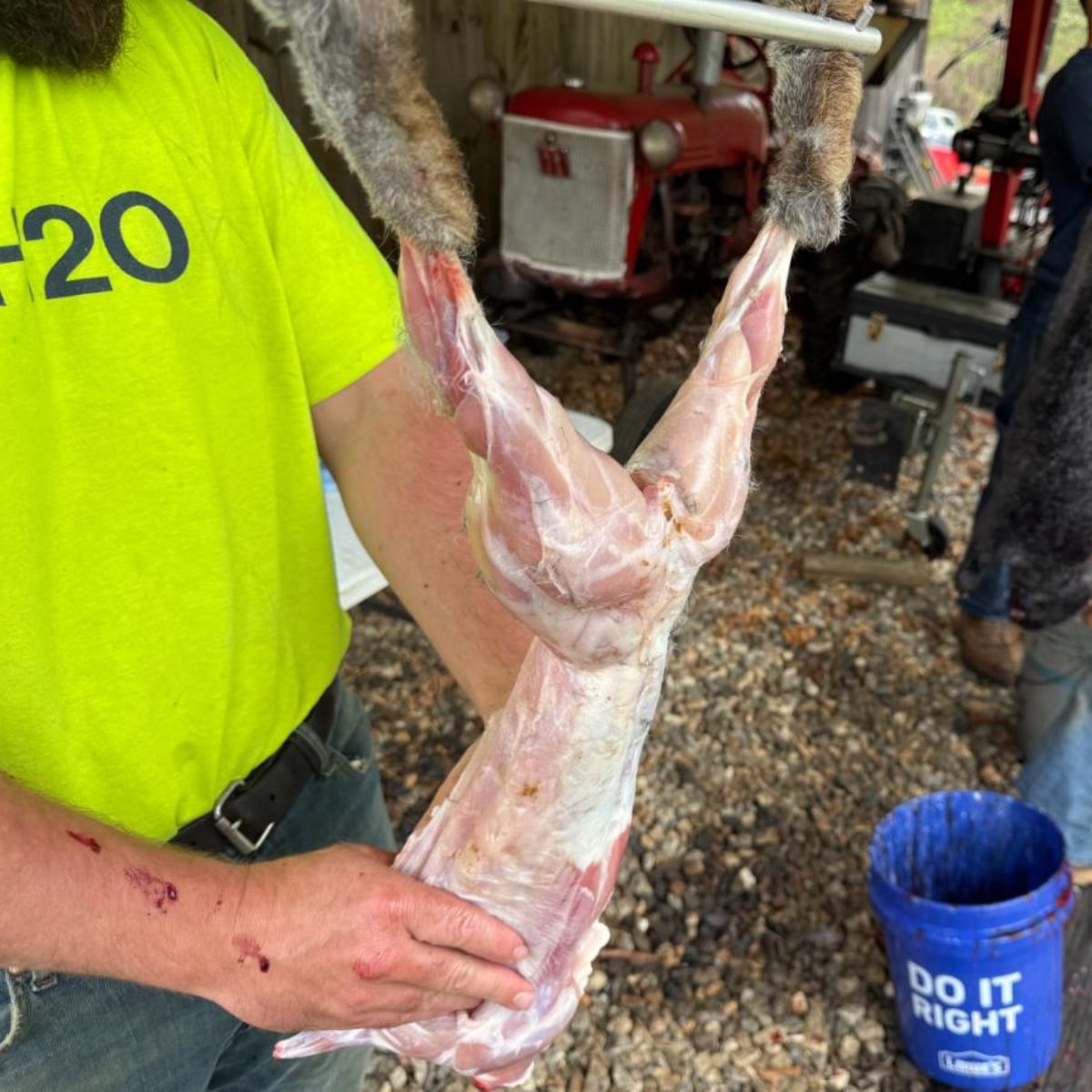
There are a few points on a rabbit carcass that will potentially pierce a freezer bag (whether vacuum or zipper style). That will allow air into the bag and, while the meat is not a loss, it doesn’t stay as good for as long.
The places that usually pierce freezer bags are the ends of the legs (front and back) and the neck bones.
There is any easy solution for this. First, fold the carcass so that the hind legs and their exposed, sharp points are tucked into the chest cavity of the rabbit.
If you’re very skilled, you can also tuck the exposed bones of the front leg ends back into the chest under the belly flaps (but this doesn’t always hold in place well the way the back legs in the chest cavity will).
Trim the neck flush with the shoulders. There is not good meat here anyway. and it’s full of neck bones. Toss that in the pet food or broth stockpile.

Use a plain, white paper towel to wrap over the exposed end of the legs and the area where the neck was. This will serve two purposes, actually.

It will protect the bag from sharp points, and it will also absorb moisture. The towel at the neck will stop excess liquid from being sucked up into the seal area when you vacuum pack the carcass.
Last, The Process: How to Arrange and Package Meat Rabbit Carcasses for the Freezer

Here is the whole process, from start to finish, for folding, bagging, and sealing a whole meat rabbit carcass.
This will reduce failed seals and create a stronger, longer-lasting seal. A well-sealed bag should stay sealed indefinitely this way.
Before you package (days one to three after harvesting):
- After harvesting, rest your rabbit carcasses in the refrigerator for at least 24 hours. You can let them rest up to three days.
- Rest the meat in a container without extra water or brine. You only need water for a short time after butchering and only to cool out the meat. After that, you’re just making soggy meat if you leave it soaking.
- Do cover the carcasses while in the refrigerator so they don’t get dried out. If a spot or two does get dry, don’t worry about it. It is safe and will be fine in the end. Ideally, though, you want to avoid that. Plastic wrap, a covered tote, or a clean plastic bag tucked over the top of the rabbits will do.
- At first, meat rabbit carcasses will have rigor mortis set in, but that will relax away after 24 to 48 hours of rest. Then, the body will be quite relaxed, movable, and pliable. This is a good time to package your rabbit meat for long-term storage.
When you’re ready to package and freeze:
- Always work on a clean, sterilized surface or cutting board.
- Work the carcass a little bit to make it bendable. Basically, bend the spine into a curl towards the belly once or twice.

- If needed, work and bend the back legs a bit.
- Take both back legs and bend them forward into the body cavity.

- Tuck the exposed ends of the legs into the cavity behind the ribs.

- The ribs will hold the legs in place.
- Arrange the belly flaps around the outside edge.
- Now, fold a section of paper towel, folded in half, over the exposed ends of the front legs.


- Use these to place and push your whole dressed rabbit into the bag, with the back to the bottom seal.

- Push the carcass in as far as it will go, as compactly in the bottom of the bag as you can get it (within reason).
- Fold the front legs into the curl of the body.
- Place a second paper towel over the neck area. Cover any sharp bones or exposed bone points. Let the paper towel sit a little loose to fill the neck of the bag. (as the bag vacuums, this will stop any loose liquid and preserve the seal area).


- If your sealer has a “moist” setting, set that to “on”.
- Now, lay your bagged whole rabbit flat and seal according to your machine’s instructions.

- Label your packaged whole rabbit, then freeze.

How Long Will Properly Packaged Rabbit Meat Last in the Freezer?

Well-packaged rabbit meat will last in the freezer as long as any other type of meat. It is, naturally, most comparable to chicken, but really, they’re all the same. The quality and protection of the packaging is what makes a difference.
Vacuum sealed rabbits will last for at least a year. (Six to 12 months is what “they” say, but I’ve taken rabbits sealed this way out of the freezer a year or more later and they’re perfect. As long as the seal is intact, they will not freezer burn in that time.)
Even packed in a zipper freezer bag like a Ziploc (™), your whole rabbits will last for that time (6+ months, up to 12).
This method of folding your rabbits into themselves, tucking the bones and protecting packaging from sharp points will leave you with a professional-looking butchered and packaged rabbit that is ready to last a long time in freezer storage. Longer, probably, than you’ll even need it to.



Leave a Reply