
When you buy meat rabbits, you may or may not be offered a pedigree. Some sellers will automatically include a pedigree, and will say in their listings that the rabbits are pedigreed.

Others will offer a pedigree, and may also note that their rabbits are pedigreed, but will charge an additional fee for the pedigree.
Some breeders will not offer pedigrees at all.
Some buyers will insist on a pedigree. Others, not so much.
So what's the real word on meat rabbit pedigrees? Are they important? Useful?
Just how important are they?
Jump to:
- What is a Meat Rabbit Pedigree?
- What Will a Pedigree Tell You?
- What a Pedigree Can’t Tell You
- Pedigreed Isn’t Always Purebred
- Pedigrees Often Cost Extra
- Is a Meat Rabbit Pedigree Worth the Paper It’s Printed On?
- Do You Need a Pedigree for Meat Rabbits? Is a Pedigree Worth It?
- Do You Need a Pedigree if You Want to Show Meat Rabbits?
- Should You Keep Pedigrees for the Rabbits You Raise?
- What Can You Do If You Want Pedigrees, But Don’t Have Them?
- The Quality of the Animal Is Worth More than the Pedigree
What is a Meat Rabbit Pedigree?

A meat rabbit pedigree is an ancestral history of the individual rabbit. It is the genealogy chart for a meat rabbit, basically. A family tree.
There is nothing particularly complex about a meat rabbit’s pedigree. It is simply a list of information that tells you what other rabbits are behind the rabbit you own or are buying. You can glean a few key points from a meat rabbit’s pedigree, but it truly is just record keeping.
This is what should be listed on a meat rabbit’s pedigree:
- Parentage and ancestry going back for three generations, with the dam and sire (mother and father) listed for each generation
- Ear or tattoo number (not all rabbits have one, but if you are building pedigrees for sale, there should be a tattoo number to identify the rabbit)
- Mature adult weight*
- Breed of the individual (rabbits further back in the line may not have a breed line listed, but it should be understood that all the rabbits on the pedigree are of the same breed, even if that breed is a cross)
- Date of birth of the individual (but not ancestors)
- Sex of the individual
- Dam
- Sire
- Color (which may or may not be a color that is considered accepted by ARBA or for shows, but is still okay to have in the lines)
- Registration number if the rabbit has one (many, if not most, rabbits are not registered, even high-quality show rabbits, so this is often blank)
- Grand Champion number (not always listed as this would only be for a show rabbit that has won as grand champion)
- Winnings or number of “legs” (this is also a show reference that may or may not be there, depending on whether the rabbit was shown and if it won; “legs” are wins that add up and count toward a Grand Champion designation)
- The rabbitry or the owner's name should be listed
- There may be a line for who the rabbit was sold to (you or someone you are selling to)
Notes about weights on rabbit pedigrees and when to take the weight

*Sometimes, when you buy your rabbit, the weight will not be filled in on the pedigree because the rabbit has not yet reached its mature weight. This is fine. It is standard practice when you buy a pedigreed rabbit at a young age. The rabbit should be at least eight weeks old when you purchase it.
Selling and purchasing meat rabbits at less than mature age but over eight weeks is standard practice and is completely acceptable. You will just have to take the weight and fill that information in in the future.
The weight for a rabbit’s pedigree should be taken when the rabbit has reached at least six months old; rabbits, especially medium and large meat rabbit breeds, may continue to gain after six months, though so many breeders will wait even longer before taking and recording that weight to make sure their rabbits have reached a settled mature weight. You might wait as long as eight or nine months before taking the weight for the record.
Just don’t forget to take the weight and record it at some point. You can take the weight any time the rabbit is alive, but if that information gets missed and the rabbit passes on, technically, the pedigree is incomplete. Some people make up a missing weight for an ancestor they don’t have, which is not strictly honest, but is also not uncommon. Things like this are part of why pedigrees have moderate value.
What Will a Pedigree Tell You?

The information on a pedigree is somewhat basic. It can, however, be a useful tool, albeit a limited one.
What is most useful about a meat rabbit’s pedigree is that it is good record-keeping. For a small amount of money, you will have a record of the rabbit’s parents and date of birth. That can make it easier to keep records straight in your rabbitry. Think of it as paying a few more dollars for the records you don’t have.
If you’re buying more than one rabbit, you’ll know who is or isn’t related and how close that relationship is. This can help you decide if linebreeding would be beneficial or if you want to diversify the gene pool more by mixing unrelated pairs of rabbits.
Having a pedigree can also come in handy if you buy rabbits from different rabbitries. The ancestry can reveal if there is a close relation in the different lines, even if they come from different places.
For example, you might buy a rabbit from breeder A and one from breeder B. But if breeder B bought their rabbit from breeder A to begin with, the rabbits may be more closely related than you expected. This may or may not matter to you, but it is good to know, especially if you have taken the extra steps to locate two different breeders and buy rabbits from what you think are two different lines for the sake of genetic improvement and diversity.
This can be even more important for rabbits of the less popular breeds, or for meat rabbits that are on a conservation list. The fewer breeders that are keeping rabbits of a specific breed, the tighter the genetic circle becomes between them.
The pedigree will give you a limited amount of information in regards to whether the rabbit is following along the lines of the standard for the breed, at least for things like mature weight and color.
Awards from showing will only tell you that the rabbit was deemed top of its class in a competition among others of the breed. It should at least be an indication that they are of good quality, as far as the standard of perfection for that rabbit breed goes.
What a Pedigree Can’t Tell You

There is a lot that a pedigree won’t reveal, though.
A pedigree will not tell you anything about the health of the meat rabbit. A pedigree won’t tell you things like
- If the rabbit has a sensitive digestive system
- If the rabbit has careful dietary needs
- If the rabbit is easily stressed or gets sick under slight stress
- If the rabbit displays respiratory symptoms or illness
- How the rabbit looks in terms of body conformation (this is not included even for show rabbits; it’s something that has to be physically observed)
- Alignment and health of teeth, feet, nails, eyes, or coat
- If the rabbit has a bad temperament
- If the rabbit is hard to handle or is aggressive
- If the doe is a good mother
- If the buck is gentle with breeding does
- How large of litters does produce (or bucks for that matter)
- The care or conditions under which the rabbits were kept
- How quickly the rabbit reached its ideal adult weight (fast or slow grower?)
- The grow out rates of its offspring, or
- The grow out rates of offspring from that genetic line (which may be more reliable information for younger breeders that are not yet bred or proven)
- If the kits and grow outs are prone to weaning enteritis (diarrhea) or other issues
If the rabbit was never shown, the pedigree may not give you much insight into how correct the animal is for its breed, or how it compares to others. Even if it was shown, show award or winnings listings might be marginal information.
After all, you have no way of knowing how big the class was that the rabbit won, or if the other competitors were quality rabbits. What if that prestigious award is just the best of two or three? (That said, Grand Champion legs do require that at least five different rabbits were in the class and that they were owned by at least three different exhibitors.) What if the rabbit was the best of five mediocre rabbits that technically fit the breed standard, but that weren’t much competition at all?
In short, though a pedigree can be an easy record, and one that you might want if you care to get into selling purebreds or showing meat rabbits, there is more that a pedigree cannot tell you than what it can.
Pedigreed Isn’t Always Purebred

Here is something else that is important to know about pedigreed rabbits.
A pedigree does not always mean that a rabbit is a purebred. Any rabbit can have a pedigree.
Even a rabbit that is a cross, or “meat mutt,” can have a pedigree. Its breed should then list whatever breeds are known to be in the lineage, and the line should read something like “Californian New Zealand mix”.
If the rabbits are purebred, they don’t even have to meet the standard of perfection for the breed in order to be on the pedigree. They just have to be of the same breed. So there is a potential that an ancestor could have a poor body type or could have color genetics that are not accepted by governing bodies like the American Rabbit Breeders Association (ARBA).
This may or may not matter to you, but is something to know just the same. There is a potential there for your purebred rabbit to throw off-color or off-standard animals in their litters.
A pedigree is truly just a family tree for the rabbit in front of you. Unless you know the rabbits in the ancestry or they have a widespread reputation, that information is mostly only a list of names, colors, and weights, with perhaps some show winnings if applicable.
Pedigrees Often Cost Extra

Many breeders will charge extra for the pedigree itself.
Some breeders will provide the pedigree without the option of not including it, even if it is available, so you can decide to save that money if the pedigree is not important to you.
Some breeders who keep pedigreed rabbits automatically include it, but charge extra for the rabbit. This doesn’t always mean that that rabbit is the best you can buy, or even that it is the best that the breeder has to offer.
Each breeder is free to manage their rabbits, pedigrees, and pricing according to their own perspective and practices. Some say they charge more for pedigreed rabbits because they only keep the best of their best. Therefore, those rabbits are of higher quality, and there are fewer for sale because of selection for sales.
It is smart to find out how a breeder handles pedigrees and pricing, and what their thought process or policy is that backs up their decisions on how to offer the records and what to charge. It is their decision to make, but knowing why they think a pedigree adds value will help you evaluate whether the pedigree or buying pedigreed stock is right for you.
A pedigree can raise the price of a meat rabbit anywhere from around $10 to $25 USD. Perhaps even more. It is up to you to decide whether there is value to you in paying that price.
Is a Meat Rabbit Pedigree Worth the Paper It’s Printed On?
Do You Need a Pedigree for Meat Rabbits? Is a Pedigree Worth It?
The short answer?
No. You do not need a pedigree for any reason for a meat rabbit. Not even for an excellent quality breeder meat rabbit.
The piece of paper does not give the rabbit better structure or meat traits.
The piece of paper cannot make the grow out reach harvest weight faster, or be heavier when it reaches your target harvest age.
For a reasonable amount of money, for the ease of record keeping, and for adding perceived value to future rabbits you might sell, a pedigree might be worth it to you. But there is no practical reason you need a pedigree for a meat rabbit to put meat on your table.
Do You Need a Pedigree if You Want to Show Meat Rabbits?

You might think you need a pedigree if you plan to show your rabbits. Showing rabbits can be an interesting, fun, and educational experience. It can also be a good place to buy new rabbits!
You do not need a pedigree to show your meat rabbits. You don’t even need one if it is an ARBA-sanctioned rabbit show.
Rabbits are not judged according to their pedigree. Rabbits are judged according to how well they compare to the standard of perfection that has been set for that breed.
If you are interested in showing meat rabbits, you’d do best to select the best quality animal you can find rather than to buy based on the longest pedigree.
A pedigree may be beneficial if you have successful show rabbits
Many people who show prefer to keep pedigrees, and they often prefer to buy pedigreed rabbits.
Knowledgeable show breeders may recognize the legs, awards, and even ancestral lines of top-performing rabbits. They can check to see if any within the line have been registered with ARBA or another governing body (registration is an entirely different process, less common than pedigrees, and also not at all necessary to show or sell good meat rabbits).
For this reason, you might find it easier to sell stock to breeders who show if you keep pedigrees and if you offer pedigreed animals for sale. But it is not actually required.
Should You Keep Pedigrees for the Rabbits You Raise?

To be clear, pedigrees are not a bad thing. They can be a good tool. Just a tool with limitations.
Whether you decide to personally keep pedigrees or not is up to you. Having some good records that can reveal things like starting growing lines, good performers, fast growth rates, and other favorable traits, along with parentage and date of birth, can be very helpful. This can help you plan for breeding, selection, retirement, and replacement.
A lot of that is not information that will come from the pedigrees you keep, but information that will come from the records you keep. It will come more from comparing records and performance than from the family tree of the rabbit.
A pedigree is not particularly difficult to keep, though. It is not difficult to build if you have a record of the necessary information somewhere else.
It can be useful and valuable to offer a prospective buyer a pedigree. It is also valuable to be able to give them real, tangible information like the average growth rate of your grow out rabbits.
At the end of the day, your desire for records, plans, and sales goals, and the preferences of your buyers are what will dictate if keeping pedigrees is a good choice for you, and if it’s worth your time and effort.
And if you just want to produce litters of grow outs that you eat, then that is perfectly fine, too. It's the value that a pedigree adds for you that decides whether keeping one is worthwhile.
Not all of your rabbits need pedigrees, either
Keep in mind, you don’t have to keep pedigrees on every last rabbit or grow out even if you do decide to keep pedigrees. You might only decide to keep a pedigree for a rabbit that shows great promise. Those you plan to eat, cull, or select out probably aren’t worth bothering to keep a record of.
If a rabbit is bound for the freezer in a few short months, there’s no need to keep track of every ancestral individual.
What Can You Do If You Want Pedigrees, But Don’t Have Them?
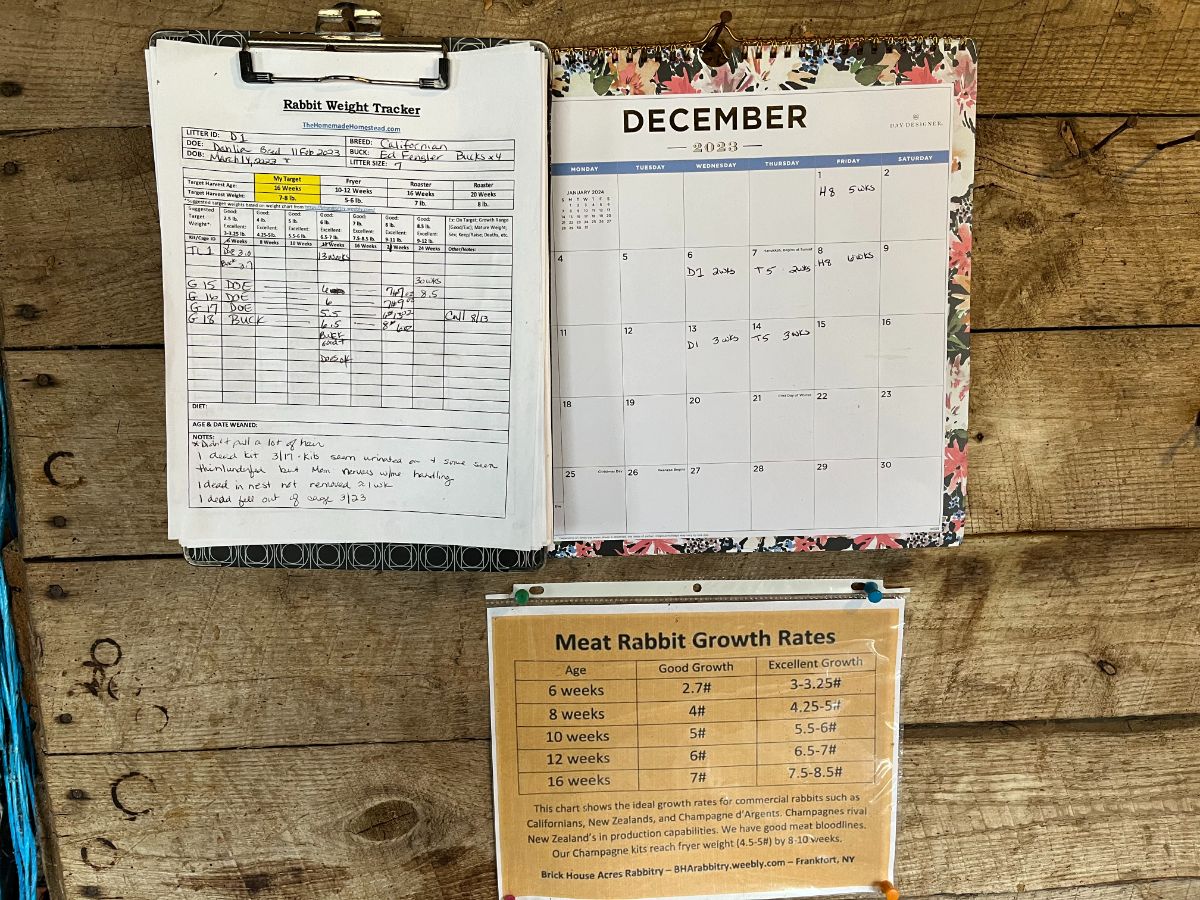
If you do decide you want pedigrees for some or all of your rabbits, you can build a pedigree on your own, even if you have no background information on the lines of rabbits you currently have.
To build a new pedigree, all you have to do is keep that basic parentage information for three generations. If you have some background information, you can start there. If not, your current rabbit and its mates will be the first generation. Then add to the pedigree for each generation forward, until you have three behind the rabbit you are targeting.
There is not one single pedigree form or format you need to keep. There are many basic pedigree templates you can choose from. There are even online apps you can use, and then turn into a printable or paper copy as needed.
You could even just look at an online template or copy the style and lines that are on a pedigree you already have, and rebuild it in a word processing template or document.
Handwritten pedigrees are perfectly acceptable, too!
It’s the information that matters, not the presentation.
The Quality of the Animal Is Worth More than the Pedigree
A pedigree can be useful. It can make record keeping easier, especially if you are buying new animals.
At the end of the day, though, a pedigree is a piece of paper. A piece of paper that can be reconstructed. A piece of paper that is only as good as the information and integrity that is behind it.
In all costs, what is more important than the pedigree is the quality of the rabbit it represents. A high-quality meat rabbit will always be worth more than a pedigreed rabbit of lesser quality.
Focus first on the rabbit in front of you. Make that what you look at the most. Evaluate the rabbit for what you can see, hear, touch, feel, and observe.
When you focus on the quality, and you obtain the best meat rabbits that you can, then you can start building a pedigree of animals that are really worth recording and reproducing.
A pedigree is a representation, but it is a representation with its limits. It is up to you to decide how useful and of how big an importance that paper proves to be.

Leave a Reply